
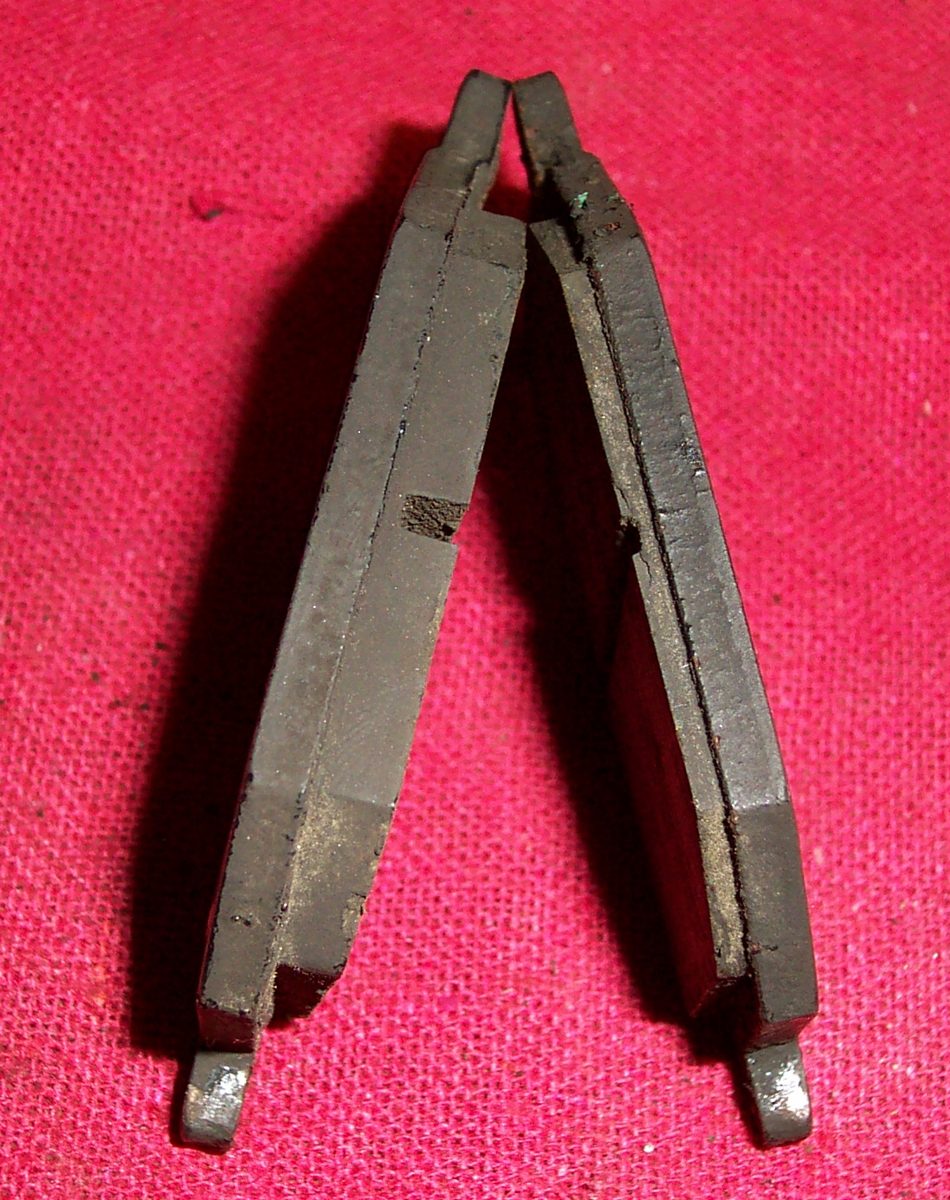
Brake pads are the two blocks of friction material that squeeze the disc. They wear a little every time you brake. This check tells you how much material is left, so you can change the pads before the metal backing plate touches the disc. Do it at every service and whenever the brakes squeal, grind or feel weak.
Safety
- Park on firm, level ground with the bike on its centre stand or held upright. A bike that falls can break your foot.
- A disc can be very hot after riding. Let it cool before you put your fingers near it.
- Do not touch the pad faces or disc with oily fingers. Oil on a pad stops it gripping.
You need
- A torch and, if the caliper is hard to see, a small mirror.
- A ruler or vernier caliper if you remove the pads.
Steps
- Find the caliper: the clamp that sits over the edge of the disc. Some calipers have a small cap or window on top for pad inspection; remove it if fitted.
- Shine the torch into the gap between the caliper and the disc. You should see two pads, one on each side of the disc.
- Look at the friction material on each pad, not the metal plate behind it. Many pads have a groove cut across the middle (the wear groove). If the groove has gone, the pad is at its limit.
- Compare both pads. The inner pad (next to the wheel) often wears faster and is harder to see. Use the mirror.
- If you cannot see the pads clearly, remove them as in Replace disc brake pads and measure the friction material only. Limit: 3 mm (K-Light 125, front and rear; new pads are 6.0 mm). For other bikes use the limit in your manual.
- Look at the disc while you are there: deep grooves, a blue colour or a sharp lip at the edge mean you should also do Check a brake disc.
- Check the brake fluid level at the same time. As pads wear, the level in the reservoir drops a little: see Check brake fluid level and condition.
Check your work
- You know the thickness of every pad on every disc brake on the bike.
- You have written the date and distance in the service record.
- If any pad is at or below the limit, you replace both pads in that caliper (K-Light 125 manual requires both).
If it did not fix the problem
- Pads below the limit, metal showing, or a pad cracked or loose: Replace disc brake pads. Do not ride on a pad with metal showing.
- One pad much thinner than the other, or tapered: go to Brake pads wear unevenly.
- Pads fine but the brake is weak: go to Brakes are firm but do not stop the bike well.
Reference values (K-Light 125)
| Item | Value | Source |
|---|---|---|
| Pad friction material, new | 6.0 mm front and rear | K-Light 125 manual, PDF p. 66 and 109 |
| Pad friction material, service limit | 3 mm front and rear | K-Light 125 manual, PDF p. 66 and 109 |