
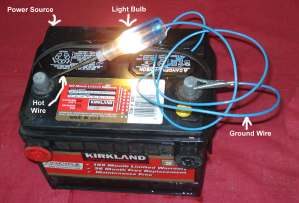
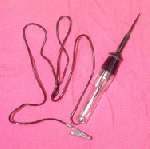
You turn the key and nothing happens: no dashboard lamps, no fuel pump hum, no lights, no horn. When everything is dead, the fault sits before the point where the circuits split: the battery, the battery cables, the main fuse, the ignition switch, or the main earth. The K-Light manual lists exactly these for "no power": an over-discharged battery, a battery wire not connected, a broken fuse and a defective power switch (PDF p. 76).
Is it safe to ride?
The bike cannot run. Do not try to push-start a fuel-injected bike with no power. Push it off the road.
Quick checks first
- Are the battery cables connected and tight? Try to turn each terminal by hand.
- Is there an alarm or immobiliser that cuts power? Try its remote or the spare key.
- Electric motorcycle: go to Dashboard is dark and the bike seems dead.
- Was the bike parked for a long time, or was something left on?
- Is there a burning smell? If so, keep the key off and see Burning smell from the wiring.
Diagnose it step by step
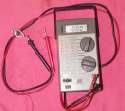
1. What does the battery read? Set the multimeter to DC volts (V with a straight line), 20 V range. Red probe on the battery positive (+) terminal, black probe on the negative (-) terminal. Touch the lead posts themselves, not the cable clamps.
- Very low or 0: the battery is flat or dead: Test and charge a 12 V battery. Then find out why: Battery goes flat after the bike is parked.
- Good: go to step 2.
2. Does the voltage reach the cables? Move the probes from the posts to the cable clamps.
- Lower than on the posts, or it changes when you wiggle the clamp: the terminal is loose or corroded: Clean and tighten battery terminals.
- Same: go to step 3.
3. Is the main fuse good? Test it with the meter: Check fuses and relays. K-Light 125 main fuse: 20 A, near the battery (PDF p. 278).
- Blown: fit one new fuse of the same rating. If it blows again, stop: Fuse keeps blowing.
- Good: go to step 4.
4. Does battery power reach the ignition switch? Key off. Find the ignition switch connector. Meter on DC volts, black probe on battery negative, red probe back-probed into the feed wire (push a thin pin into the back of the connector along the wire).
- 0: the wire from the main fuse to the switch, or a connector on it, is broken: Find a wiring fault.
- Battery voltage: go to step 5.
5. Does power come out of the switch with the key on? Key on, back-probe the output wire. The K-Light 125 switch connects red/white 1 to red, and red/white to orange/blue, in the ON position (PDF p. 102).
- 0 on the output: the switch has failed: Test the ignition switch.
- Battery voltage: go to step 6.
6. Is the main earth good? Red probe on battery positive, black probe on bare frame metal, key on. The reading should be close to battery voltage.
- Low or 0: the battery negative cable to frame is loose or corroded: Clean and tighten earth connections.
- Good: power and earth are present, so the fault is in a shared connector or relay after the switch. On the K-Light 125, the FI lamp should light at key on if the injection system has power (PDF p. 269). Follow Find a wiring fault.
7. Alarm, tracker or immobiliser fitted? Many aftermarket alarms cut the ignition feed. If the bike works with the alarm bypassed by its installer, the alarm is faulty: Problems after fitting accessories or an alarm.
Causes, most likely first
| Cause | How to confirm | Fix |
|---|---|---|
| Flat or dead battery | Low voltage at posts | Test and charge a 12 V battery |
| Loose or corroded battery terminal | Lower voltage at clamp than post | Clean and tighten battery terminals |
| Blown main fuse | Meter test | Check fuses and relays |
| Failed ignition switch | Feed in, no output | Test the ignition switch |
| Main earth loose | Low voltage to frame | Clean and tighten earth connections |
| Alarm or immobiliser cutting power | Works with alarm bypassed | Wire an accessory safely |
Reference values (K-Light 125)
| Item | Value | Source |
|---|---|---|
| Main fuse | 20 A | PDF p. 278 |
| Ignition switch ON connections | red/white 1 to red; red/white to orange/blue | PDF p. 102 |