
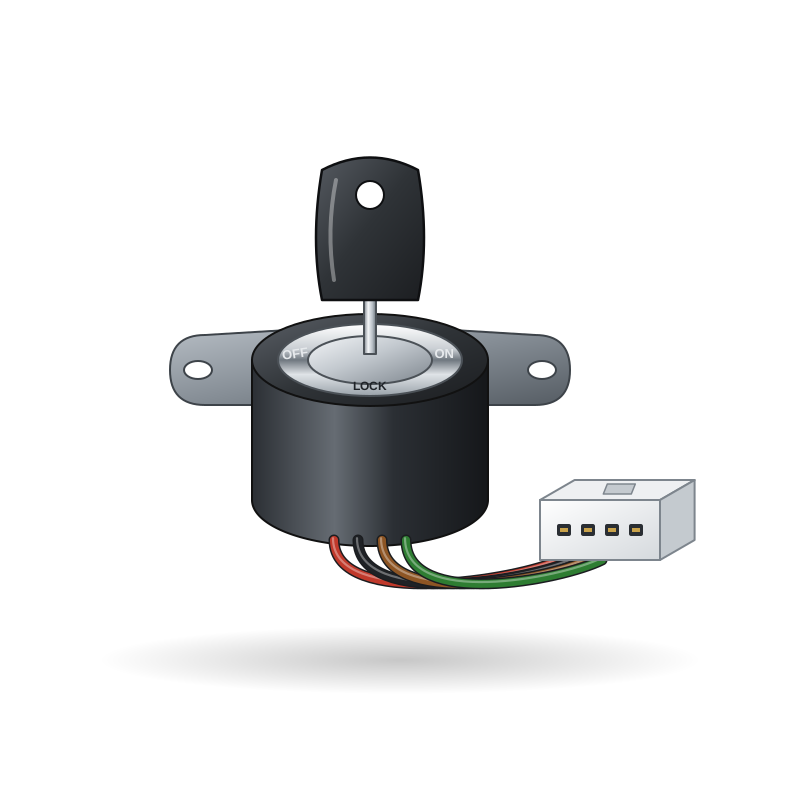
The ignition switch is the key switch, usually on the top yoke between the handlebars. Many also lock the steering. Behind it a short loom runs to a plug. On electric bikes the key switch turns on the low-voltage system that wakes the controller.
What it does
Turning the key to ON connects battery power to the rest of the bike: ignition, injection or CDI, lights, horn and instruments. In OFF or LOCK every circuit is open. The switch has small contacts inside that carry all this current. They wear, get dirty or burn, and water and dust get in. A worn key or lock barrel makes the key stiff or loose.
Signs it is worn or failing
- Ignition switch is stiff or cuts power.
- Nothing happens when the key is turned on.
- Cuts out on bumps or when the key or bars are moved.
- Electrical faults come and go.
When to replace it
When the contacts fail the continuity test, the plug is melted, or the lock is broken. Clean the plug and check the wiring first. A worn key can often be replaced on its own.
What to match when buying
- Match make, model and year: number of positions (OFF, ON, LOCK, PARK), wire colours, plug and mounting.
- Switches are often sold as a lock set with tank cap and seat lock, all with one key. Buying only the switch means two keys.
- Cheap switches can have thin contacts that heat up. A melted plug is a warning to check the whole circuit, not just the switch.
- Use a switch rated for DC at the load it carries: Choose the right switch for a 12 V circuit.
Fitting notes
- Home job: Test the ignition switch. Disconnect the battery negative first.
- Mounting bolts are often shear-head security bolts; removal may need drilling.
- Seal the plug against water: Clean and seal electrical connectors.
Reference (K-Light 125)
| Item | Value | PDF page |
|---|---|---|
| Plug | 4 pins: red/white 1, red, red/white, orange/blue | 102 |
| ON position | red/white 1 to red, and red/white to orange/blue, connected | 102 |
| OFF and LOCK | no continuity | 102 |