
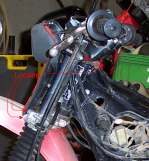
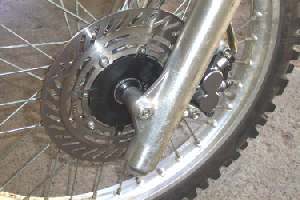
You hear or feel a single knock from the front of the bike when you apply the front brake, or when you rock the bike with the front brake held. Something at the front has play. The most likely places are the steering head bearings, the fork bushes inside the legs, a loose caliper or caliper bracket, a loose axle or pinch bolt, or a loose disc. A small tick from pads moving in the caliper can be normal on some bikes, but a clunk is not.
Is it safe to ride?
No. A loose caliper, axle or steering head is dangerous. Find the source first.
Quick checks first
- Hold the front brake and rock the bike forward and back. Feel with your free hand at the top of the head tube, then at the fork legs, then at the caliper.
- Push the caliper by hand: does it move?
- Check the axle nut and pinch bolts.
- Check the handlebar clamp is tight.
Diagnose it step by step
1Is the caliper, caliper bracket or any caliper bolt loose?
- Yes: do not ride. Tighten to the model torque from your manual. If a bolt thread is damaged, replace it. No caliper torque is given here because the K-Light 125 manual lists two different values.
- No: go to step 2.
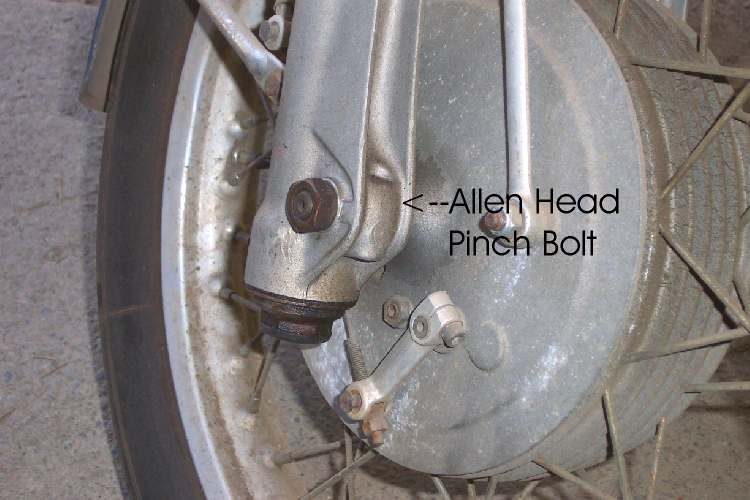
2Is the axle nut or axle pinch bolt loose, or the disc loose on its bolts?
- Yes: tighten to the model torque (K-Light 125 front axle nut: 75 to 88 N·m). See Check chassis fasteners. A loose disc: Check a brake disc.
- No: go to step 3.
3With the brake held and the bike rocked, is the clunk felt at the top of the head tube?
- Yes: steering head bearing play. Check the steering head bearings, then Adjust or replace steering head bearings. Workshop.
- No: go to step 4.
4Is the clunk felt at the fork legs, below the top clamp?
- Yes: check fork clamp bolts are tight. If they are, the fork bushes are worn. Lift the wheel and try to move each slider forward and back on its tube; play means worn bushes. Replace fork oil and seals (the workshop replaces bushes at the same time).
- No: go to step 5.
5Does the front wheel move sideways on the axle?
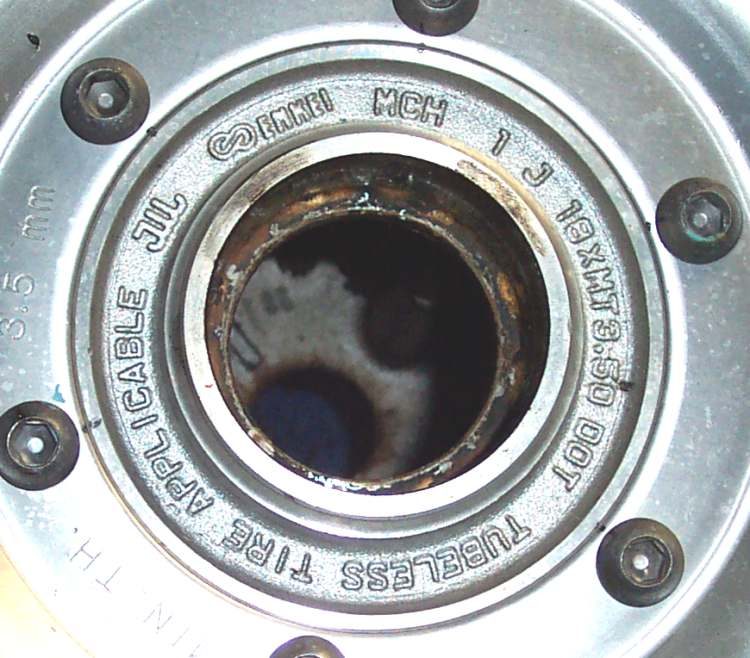
- Yes: Check wheel bearings.
- No: go to step 6.
6Does the clunk come only at the first moment of braking, as a light tick?
- Yes: pads moving in an over-sized slot or a worn pad pin. Check with Inspect the front forks and replace worn pins or pads.
- No: have a workshop check the whole front end.
Causes, most likely first
| Cause | How to confirm | Fix |
|---|---|---|
| Loose caliper or bracket | Caliper moves by hand | Tighten to model torque |
| Loose axle, pinch bolt or disc | Fastener moves | Check chassis fasteners |
| Steering head bearing play | Clunk at top of head tube | Adjust or replace steering head bearings |
| Worn fork bushes | Slider moves on tube | Replace fork oil and seals |
| Worn wheel bearings | Wheel rocks on axle | Check wheel bearings |
| Pad movement | Light tick only | Check pad pin and pads |
Reference values (K-Light 125)
| Item | Value | Source |
|---|---|---|
| Front axle nut | 75 to 88 N·m | K-Light 125 manual, PDF p. 49 |