
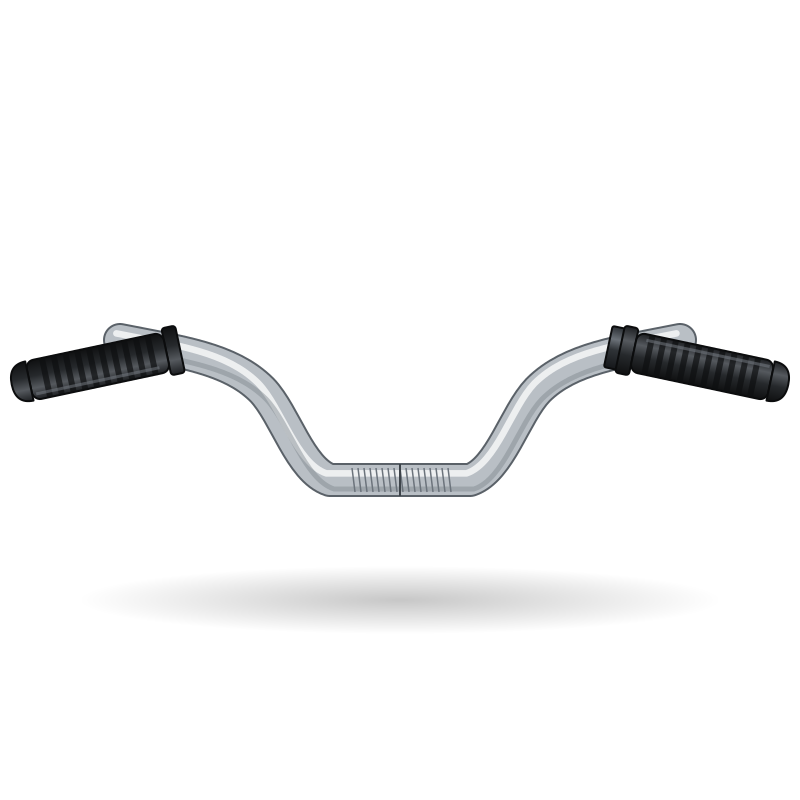
The handlebar is the steel tube you steer with, clamped to the top fork yoke, often through rubber-mounted risers. It carries the grips, the throttle twist grip, the levers, the switch housings and the mirrors. Bar-end weights at each end reduce vibration.
What it does
The bar turns the forks. The grips give you a firm hold; the right grip is the throttle and must turn freely and snap back. Falls bend bars and tear grips; loose clamps let the bar rotate in its mounts, which is dangerous.
Signs it is worn or failing
- Bar not straight when the wheel points straight: Handlebar not straight.
- Throttle sticks or does not snap shut: Throttle sticks. Stop riding until fixed.
- Bar moves in its clamp, or the grip turns on the bar.
- After a fall: The bike has been dropped or crashed.
- Vibration through bars: Vibration at certain speeds.
When to replace it
Replace a bent or cracked bar; do not straighten steel bars that have been bent a lot, because they weaken. Replace grips that are torn, loose or slippery. Replace riser rubbers if cracked.
What to match when buying
- Bar diameter (22 mm, also called 7/8 inch, is common), width, rise and bend shape. Check that cables and hoses still reach at full lock.
- Some bars have holes or dowels for switch housings; match those.
- Grips: right grip inner diameter fits the throttle tube, left fits the bar. Many are sold as a pair.
Fitting notes
- Tighten clamp bolts evenly, front bolts first if the manual says so, to the value for your bike.
- After fitting, turn bars lock to lock and check the throttle snaps shut in every position.
- Align: Align the front wheel, forks and handlebar.
- See Check chassis fasteners.
Reference (K-Light 125)
| Item | Value | PDF page |
|---|---|---|
| Handlebar upper clamp screws (M8×25) | 22 to 29 N·m, marked screws last | 133, 145 |
| Bar-end weight screw | 10 to 12 N·m | 145 |