
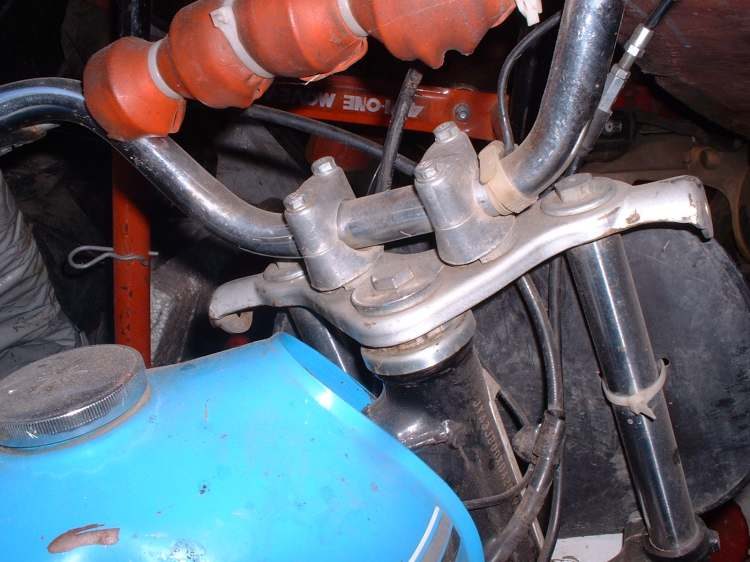
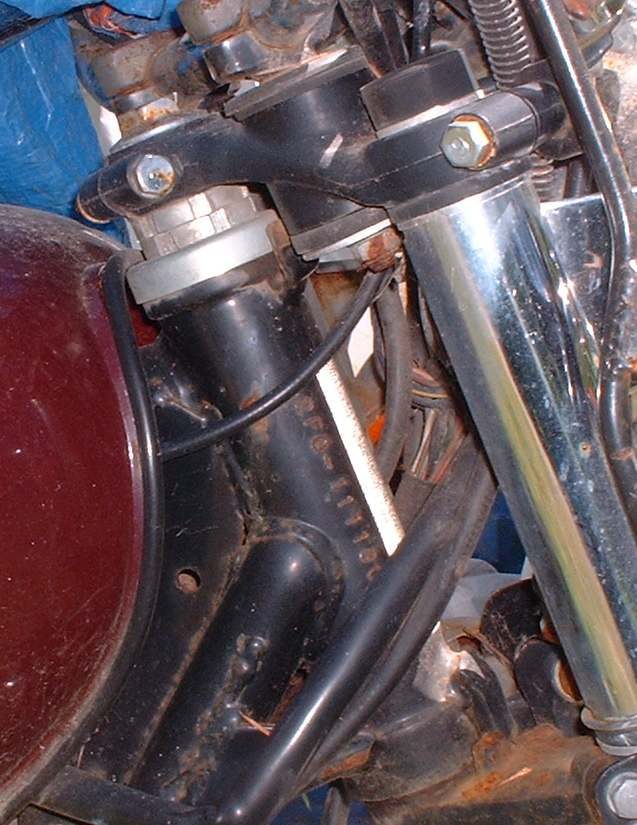
Steering head bearings are set with a special slotted adjusting nut under the top yoke (the upper fork clamp). Too loose and the front end clunks and wobbles. Too tight and the steering is heavy and the bike weaves. If the races are dented, only new bearings will cure it. Because the adjustment sets how the bike steers, and because getting it wrong can cause a crash, this page is an assessment and hand-off.
Safety
- Do not ride with clear steering head play, a notch you can feel in the centre, or steering that does not return freely.
- Do not hammer races in or out without the right drifts and support: a race fitted crooked fails quickly.
- No adjustment torque or ball count is given here. The K-Light 125 manual gives two different adjusting-nut values and two different upper ball counts on different pages, so the workshop must confirm the exact procedure for the model.
What you can check before the workshop
- Do Check the steering head bearings and note: loose, tight or notchy.
- Check the front tyre, front wheel bearings and fork clamp bolts are not the real cause (Check wheel bearings, Check chassis fasteners).
- Note any crash or kerb strike. A bent fork or frame can feel like a bearing fault (Inspect the frame after a crash).
What the workshop will do
- Loose only, races smooth: loosen the top yoke and stem nut, turn the adjusting nut with a steering nut wrench to remove play, retighten the stem nut and yoke bolts to the model torques, and recheck free movement.
- Notchy, rough, or loose again soon after adjustment: strip the front end (wheel, caliper, mudguard, forks, handlebar, top yoke), remove the stem, and replace balls or rollers and all races as a set. Old races are driven out of the head tube and the stem; new ones are fitted square.
- Grease the bearings well with waterproof grease. On cup-and-cone loose-ball bearings, fit the correct number of balls in each race. Tapered roller bearings are packed with grease.
- Seat the bearings, then set the final preload to the manual: the bars must turn freely lock to lock with no play.
- Refit fork tubes at the correct height in the clamps, tighten clamp bolts, axle and handlebar to the model torques, and road test.
What to ask for
- Whether the races are dented. If yes, ask for new bearings and races, not just an adjustment.
- Whether a tapered roller kit is made for your exact model. Many workshops prefer it to loose balls, but only fit a kit listed for that bike.
- A final check of lock-to-lock movement and cable routing.
Check your work
- No clunk when braking; no notch; bars fall freely to each side from the centre with the wheel off the ground.
- Steering is neutral and light on a short road test.
If it did not fix the problem
- Wobble or weave remains: Handlebars shake or wobble or Bike weaves at high speed.