
Under hard acceleration or on a bump, you feel a jerk and hear a crack as the chain skips over the sprocket teeth, or the chain comes off completely. A chain stays on its sprockets because it fits the teeth closely, is held at the right tension and runs in a straight line. When the chain or sprockets are worn, the slack is far too loose, the wheel is crooked, or a guide is missing, it can climb off. A chain that comes off can jam between the sprocket and the engine case, lock the rear wheel and break the case.
Is it safe to ride?
No. Stop as soon as it is safe. Pull the clutch in (or switch off an electric bike) and stop gently using the brakes. Do not ride on until the cause is found and fixed.
Quick checks first
- Is the chain still on both sprockets? Is the rear wheel free to turn?
- Look at the engine case near the front sprocket for cracks or oil.
- Look at the chain adjusters: are both marks the same and is the axle nut tight?
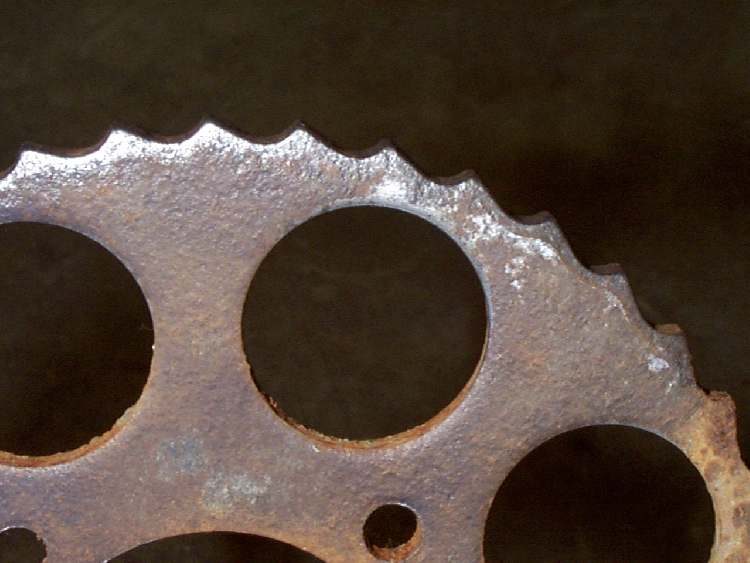
- Look at the rear sprocket teeth.
- Chain and both sprockets wear together. Replace them as a set and do not mix new parts with worn ones.
- A dished sprocket fitted the wrong way round wears very quickly. Check which way it faces.
Diagnose it step by step
1Is the rear wheel locked, or is the engine case cracked or leaking oil near the front sprocket?
- Yes: do not start the engine. Transport the bike to a workshop. See Chain has snapped for what to check.
- No: go to step 2.
2Is the slack far too loose, or are the adjuster marks different on each side, or is the axle nut loose?
- Yes: refit the chain, set the slack and align the wheel, and tighten the axle nut to the correct torque: Check and adjust chain slack. Then continue to step 3; a chain that jumped is often worn too.
- No: go to step 3.
3Are the sprocket teeth hooked, sharp or broken, or does the chain lift off the back of the rear sprocket?
- Yes: Inspect sprockets, Check the chain for wear. Replace the chain and both sprockets: Replace the chain and sprockets.
- No: go to step 4.
4Is a chain guide or slider missing or broken, or is the rear sprocket bent?
- Yes: Check chain guides, sliders and guards.
- No: go to step 5.
5Does the rear wheel or swingarm move sideways when you push it?
- Yes: Check the swingarm pivot; see Swingarm moves sideways or has play.
- No: go to step 6.
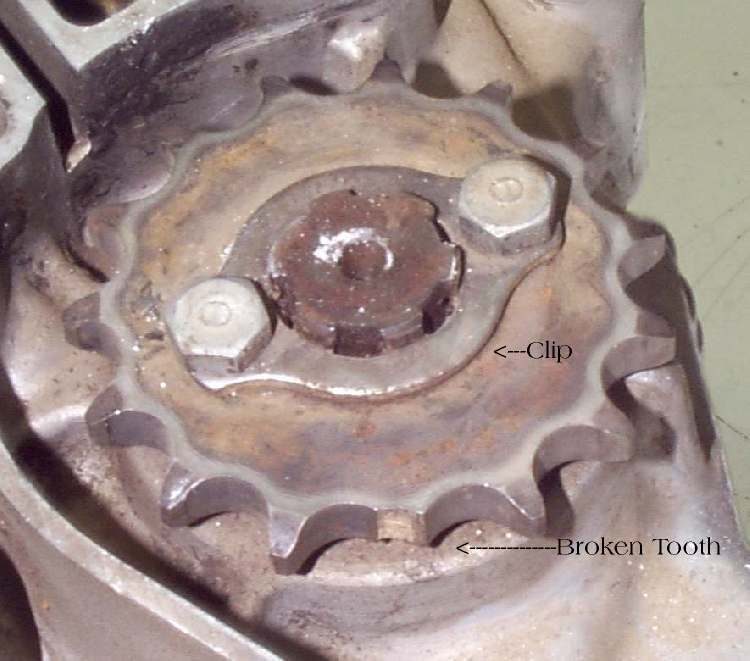
6Does the front sprocket move on its shaft, or is its retaining bolt or plate loose?
- Yes: workshop. The front sprocket and its retainer must be checked and refitted correctly.
Causes, most likely first
| Cause | How to confirm | Fix |
|---|---|---|
| Slack far too loose or wheel crooked | Slack above range, marks unequal | Check and adjust chain slack |
| Worn chain and sprockets | Hooked teeth, chain lifts off | Replace the chain and sprockets |
| Missing guide or bent sprocket | Visible damage, sprocket wobbles | Check chain guides, sliders and guards |
| Swingarm or wheel play | Sideways movement | Check the swingarm pivot |
| Loose front sprocket | Sprocket moves on shaft | Workshop |
Reference values (K-Light 125)
| Item | Value | Source |
|---|---|---|
| Chain slack, bike upright | 20 to 40 mm | K-Light 125 manual, PDF p. 61 |