
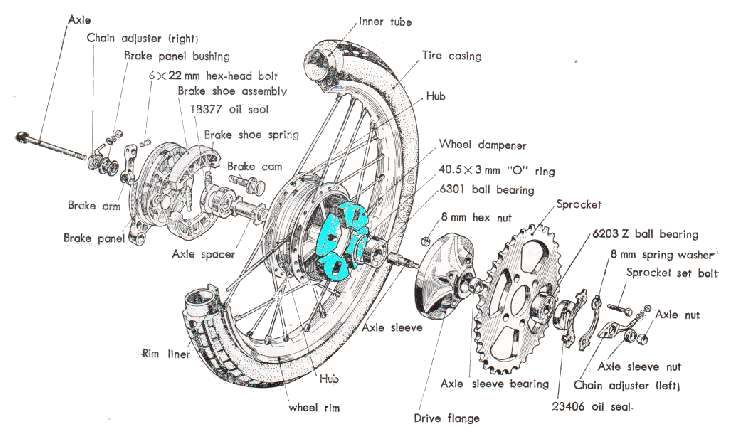
You set the chain slack and a few days later it is loose again. A new chain often needs one or two adjustments early on as it beds in; after that, frequent adjustment is a warning. The chain may be near the end of its life, the sprockets worn, the chain starved of oil or set too tight. Most serious of all, the rear wheel may be moving because the axle nut is loose.
Is it safe to ride?
Ride with care. First check the axle nut (step 1). A wheel that moves in the swingarm can pull crooked and the chain can jump off.
Quick checks first
- Are the adjuster marks the same on both sides and in the same place as when you last adjusted?
- Is the axle nut tight?
- When did you last clean and oil the chain?
- Were a new chain and new sprockets fitted together?
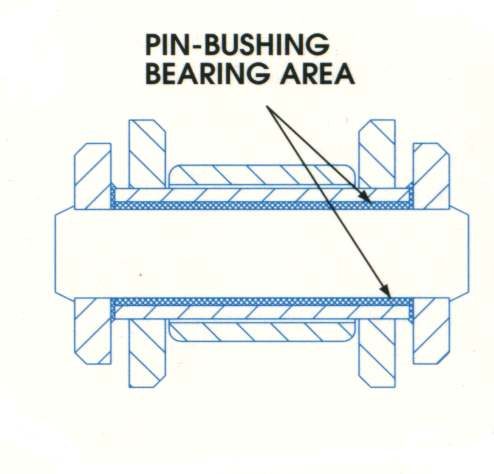
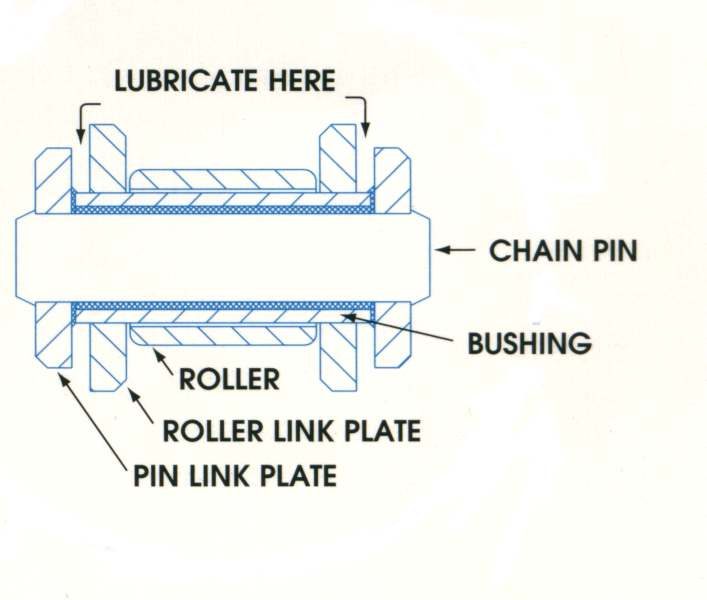
- A chain does not truly stretch. Wear in the pin and bushing joints makes it longer in pitch, and that in turn wears the sprocket teeth, so a worn chain usually means worn sprockets too.
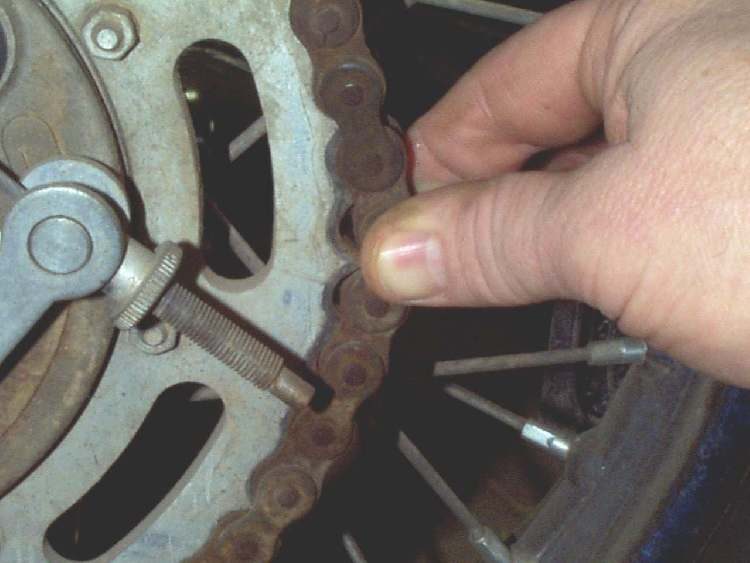
- A worn chain is hard to adjust because some spots are tight and others loose. Set the slack at the tightest spot.
Diagnose it step by step
1Have the adjuster marks moved since you set them, or is the axle nut not fully tight?
- Yes: the wheel is slipping, not the chain stretching. Reset the slack and tighten the axle nut to the correct torque (Check and adjust chain slack). Confirm the torque with a dealer; the K-Light manual gives two different values.
- No: go to step 2.
2Are the adjusters near the end of their range, or does the chain lift off the back of the rear sprocket?
- Yes: the chain is worn out. Check the chain for wear.
- No: go to step 3.
3Are the sprocket teeth hooked or sharp, or was a new chain fitted on old sprockets?
- Yes: worn sprockets wear a new chain quickly. The K-Light manual warns against mixing new and worn parts. Replace the chain and sprockets as a set.
- No: go to step 4.
4Is the chain dry or dirty most of the time, or cleaned with petrol, solvent or a pressure washer?
- Yes: dirt and lost lubricant wear the pins fast, and solvents damage sealed chains. Clean and lubricate the chain with neutral detergent and chain lubricant.
- No: go to step 5.
5Was the slack set tighter than specified? (K-Light 125: 20 to 40 mm.)
- Yes: a tight chain wears quickly and loads the bearings. Set it in range at the tightest point.
- No: go to step 6.
6Is the chain running straight, or are there rub marks and wear on one side of the sprocket teeth?
- Misaligned: Check chain guides, sliders and guards and align the wheel.
Note: heavy loads, passengers and hard acceleration all shorten chain life. On a working bike, check and oil the chain more often.
Causes, most likely first
| Cause | How to confirm | Fix |
|---|---|---|
| Wheel slipping, axle nut loose | Adjuster marks moved | Check and adjust chain slack |
| Chain worn out | Adjusters far back, chain lifts off | Check the chain for wear |
| Worn sprockets with a new chain | Hooked teeth | Replace the chain and sprockets |
| Poor lubrication or wrong cleaning | Dry, rusty, solvent used | Clean and lubricate the chain |
| Set too tight or misaligned | Slack below range, one-sided wear | Check chain guides, sliders and guards |
Reference values (K-Light 125)
| Item | Value | Source |
|---|---|---|
| Chain slack, bike upright | 20 to 40 mm | K-Light 125 manual, PDF p. 61 |