
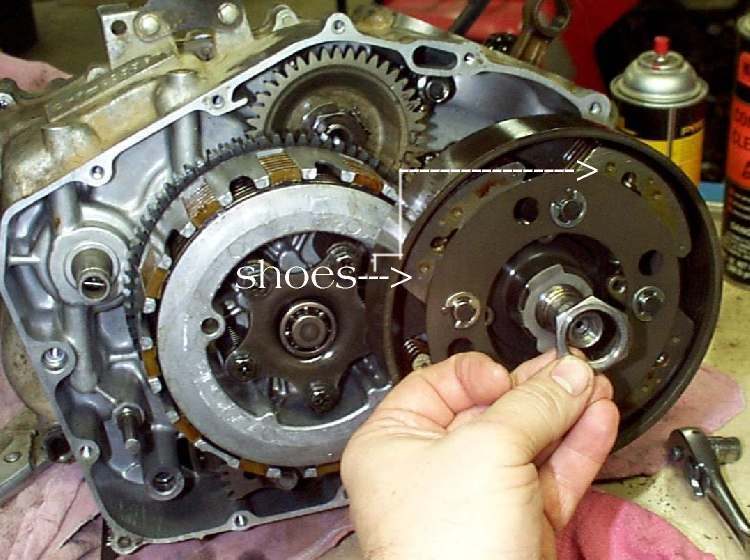
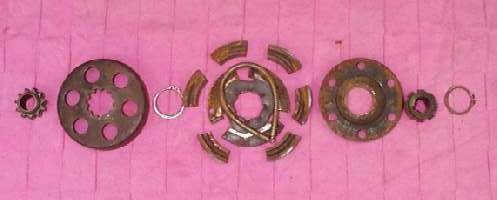
Many step-through commuters have no clutch lever. A centrifugal clutch (weights that fly out and grip as the engine speeds up) takes up the drive when you open the throttle. When you press the gear pedal, the pedal also releases the clutch for a moment so the gear can change. If the clutch slips, grabs or lets the bike lurch, start with the simple outside checks below. Opening the clutch is workshop work: it needs the cover off, holding tools and the model's settings. This page is an assessment and hand-off.
Safety
- Test with the engine running only on a centre stand with the rear wheel clear, or at walking pace on a quiet road. The wheel turns as soon as a gear is selected.
- Hot oil burns. Let the engine cool before draining.
Outside checks (rider or home)
- Oil level and grade. On most step-throughs the clutch runs in engine oil. Low, old or wrong oil makes it slip or grab. Check: Check the engine oil level. If the oil is old or you do not know its grade, change it: Change the engine oil.
- Idle speed. If idle is too high, the centrifugal part starts to grip at idle, so the bike lurches when you select a gear and creeps at junctions. See Idle speed is too high.
- Riding technique. Close the throttle fully, press the pedal firmly through its whole travel and hold it for a moment, then release. Changing with the throttle open or with a short, quick tap gives a jerk.
- Gear pedal and linkage. The pedal must move its full stroke and not touch the footpeg or engine case. A loose or bent pedal releases the clutch only partly: Check the gear lever and shift linkage.
- External clutch adjuster. Many semi-automatic engines have an adjuster screw with a locknut on the right-hand engine cover. The setting method (turn until you feel resistance, then back off a set amount, then lock) differs by model. Only adjust it with your manual's exact steps; a wrong setting makes the clutch slip or drag.
What the workshop will check
- Remove the right engine cover and inspect the centrifugal clutch: shoe or weight lining, the drum, the weight springs and any sticking weights.
- Inspect the manual clutch pack (friction and steel plates and springs) that the gear pedal releases, measuring them against the model limits.
- Check the release mechanism worked by the gear pedal (often a ball ramp or cam) for wear.
- Check for metal or burnt lining in the oil.
What to ask for
- Ask which parts were measured and against which limits, and to see the old parts.
- Ask for the external adjuster to be set and the setting explained to you.
- Ask what oil was used.
Do not attempt at home
- Do not open the clutch cover without the model manual, a new gasket and the holding tools.
- Do not fit stronger or weaker springs to "fix" engagement; it changes how and when the clutch grips.
If it did not fix the problem
- Engine revs rise but the bike does not speed up in every gear: Engine revs rise but the bike does not speed up.
- Gears hard to select even with the clutch working: Gears are hard to select.