
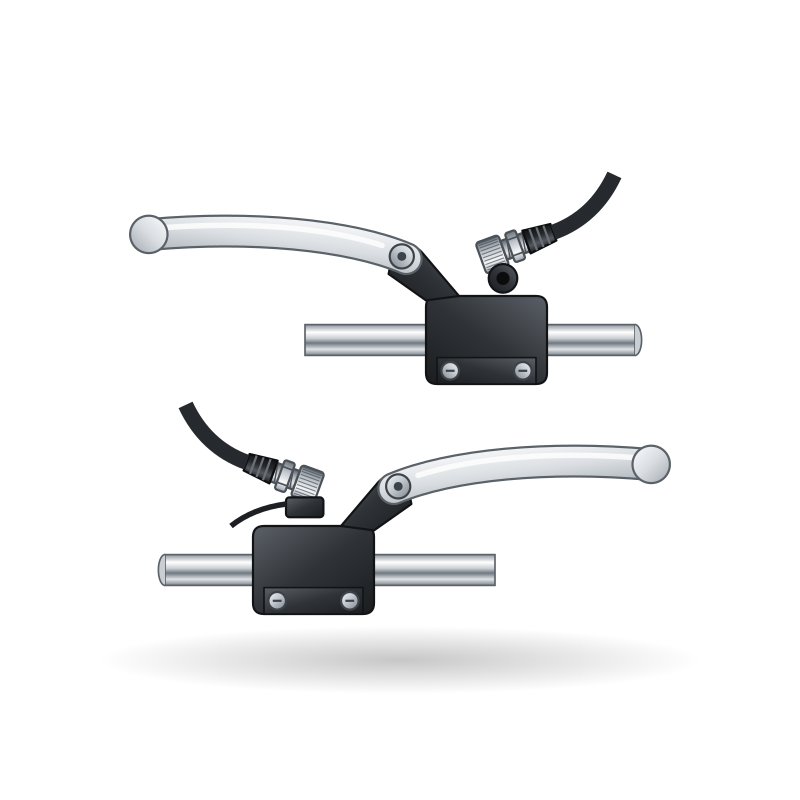
The hand levers sit on the handlebar: the front brake lever on the right, and the clutch lever on the left (or the rear brake lever on scooters and some step-throughs). Each one turns on a pivot bolt in a bracket or master cylinder.
What it does
The lever multiplies your hand force and pulls a cable or pushes a master cylinder piston. The pivot bolt must be greased so the lever moves smoothly and comes back fully. The brake lever also works the brake light switch. Levers are the first thing to break in a fall; a broken brake lever stub can still be dangerous to use.
Signs it is worn or failing
- Lever bent, cracked, loose or broken: Brake or clutch lever is loose, bent or broken.
- Lever stiff or does not return: dry pivot. A brake lever that does not return can make the brake drag: Brake drag.
- Heavy clutch: Heavy clutch. Check the pivot before the cable.
- Brake light does not come on: Brake light does not work.
When to replace it
Replace any brake lever that is cracked or bent so it cannot be fully used. A clutch lever with a broken tip can get you home slowly, but replace it soon. Replace a pivot bolt that is worn or bent.
What to match when buying
- Make, model, year, and left or right. The pivot hole, the nub that pushes the master cylinder piston or holds the cable end, and the brake light switch tab must match.
- Adjustable aftermarket levers must be for your exact master cylinder.
- Avoid brittle cast levers with rough edges or bubbles in the metal.
Fitting notes
- Grease the pivot and cable nipple with a little grease. Do not overtighten the pivot bolt; the lever must swing freely.
- After fitting a brake lever, check free play and that the brake light comes on early in the travel.
- See Service brake and clutch lever pivots.
Reference (K-Light 125)
| Item | Value | PDF page |
|---|---|---|
| Front brake lever free play | 10 to 20 mm at the tip | 61 |
| Brake light on at | About 15 mm lever travel | 67 |
| Front lever pivot bolt / locknut | 1.0 N·m / 5.9 N·m | 117 |