
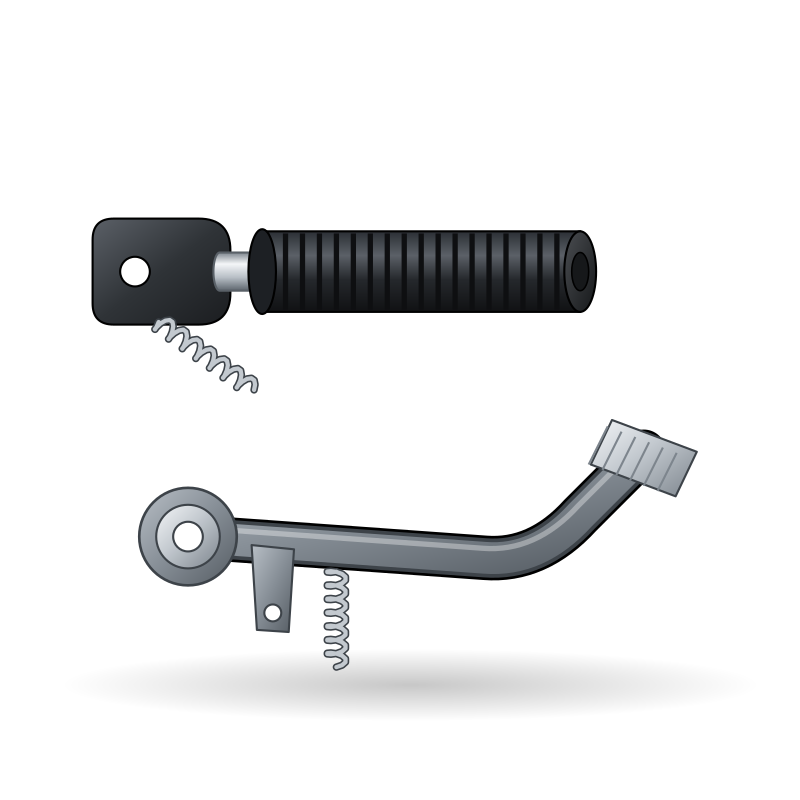
Footpegs are the rests for the rider's and passenger's feet, bolted to the frame or to brackets. The foot pedals are the rear brake pedal on the right and the gear lever on the left. Most pegs fold up on a spring-loaded pivot.
What it does
Pegs carry your weight when standing over bumps and give you a firm place to control the bike. Folding pegs swing up if they touch the ground in a fall or a tight corner, then a spring brings them back down. Pivots dry out and seize, springs break, rubbers wear, and brackets bend or crack in falls.
Signs it is worn or failing
- Peg loose, bent, stiff or will not fold back: Foot pedal or footpeg is stiff, bent or loose.
- Brake pedal stiff or slow to return: Brake drag.
- Bracket cracked: Crack in the frame or a bracket.
- After a fall: The bike has been dropped or crashed.
When to replace it
Replace a bent or cracked peg, bracket or pedal, a broken return spring, or worn-out rubbers. Do not ride with a loose brake pedal or a missing pedal return spring.
What to match when buying
- Make, model, year and position (rider left, rider right, pillion). Mounting holes and pivot pin size must match.
- Rubber covers are often sold separately.
- Replace the split pin or clip on the pivot pin with a new one.
Fitting notes
- Grease the pivot pins lightly. Check the peg springs back down by itself.
- After fitting a brake pedal, set height and free play: Adjust the rear brake pedal.
- See Service footpegs and foot pedals.
Reference (K-Light 125)
| Item | Value | PDF page |
|---|---|---|
| Footrest bolt (M10×1.25×20) | 45 to 50 N·m | 190 |
| Footpeg check | Inspect at 300, 6000 and 12000 km | 51 |