
Water leaves the engine with every burn of fuel, and condenses inside the exhaust. It rusts the silencer from the inside, so the outside can look good while the body is thin. This page finds weak spots and helps decide between a patch, a slip-on silencer and a new part. A cheap part is not always the best choice. A louder or free-flowing silencer can change how the engine runs, and the carburettor may then need re-jetting.
Safety
- Exhaust parts are very hot. Let the system cool fully, at least an hour.
- Exhaust fumes contain carbon monoxide. Do not run the engine in a closed room.
- Do not weld or braze on a tank that has fuel in it or near fuel lines.
- Do not drill holes, remove baffles or cut open a silencer to make it louder. That removes the design that matches the engine, may be illegal, and does not give a safe gain.
You need
- A torch and a wire brush.
- Padded pliers or soft jaws, or just a thumb and a cloth, so the chrome is not marked.
- A tape measure for the pipe diameter if you buy a slip-on silencer.
- Exhaust repair putty or wrap for a temporary patch.
Steps
- With the exhaust cold, look all over the silencer and the lower side. Look for rust bleeds, flaking paint, holes and wet stains.
- Tap along the body with a screwdriver handle. A dull sound or a soft dent shows thin metal.
- Squeeze the body gently by hand at several points. Where the metal gives or crunches, it has rusted through. Chrome hides rust holes, so test the whole length, and use padded jaws if you use pliers.
- Start the engine and feel (carefully, not touching the pipe) for exhaust puffs at the joints and holes. See Find and fix an exhaust leak.
- Choose a repair: - New original silencer: best fit, highest cost. - Aftermarket silencer or slip-on: lower cost, may need a carburettor change if it flows more freely. If the engine runs worse after fitting, see Engine runs hot and lean. - Repair the old one: acceptable for one hole in an otherwise sound body. Weld or braze a patch of thick plate over the hole, or wrap with repair tape as a temporary fix. A silencer that has rusted through in one place usually rusts in others.
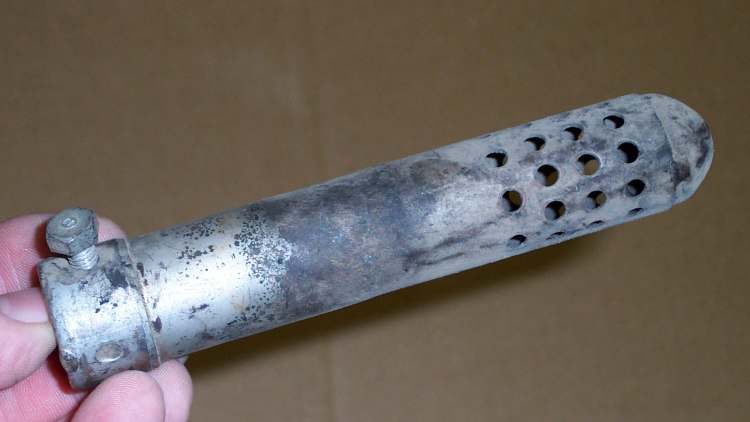
- For off-road riding, a spark arrestor is needed to stop hot carbon particles starting fires. Some slip-on silencers have one built in.
- After any repair, tighten the joints and check the gasket (Check exhaust mounts and heat shields).
Check your work
- No holes or soft spots on the body.
- No puffing at joints with the engine running.
- The sound is not louder than before the repair, and the engine runs as before.
If it did not fix the problem
- Still loud: Exhaust has become much louder.
- Ticking or puffing: Ticking or puffing from an exhaust leak.
- Power down after a change of silencer: Engine runs hot and lean.