
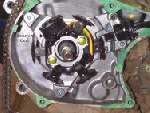
The CDI (capacitor discharge ignition unit) on carburettor bikes, or the ECU (engine control unit) on fuel-injected bikes, decides when to fire the spark. These units are expensive and rarely the real fault. Most "dead CDI" bikes have a bad connector, earth, switch, pick-up or coil. This page lists the checks to finish first, then what a workshop does to prove the unit is faulty. Test the module last.
Safety
- Key OFF before unplugging the CDI or ECU. Unplugging with power on can damage it (K-Light 125 manual).
- Never use a test lamp on ECU sensor wires; it can draw too much current. Use a digital meter.
- Never probe the back of an ECU connector with a sharp pin that can spread the terminal.
Checks to finish first (home)
- Battery. Charged and terminals tight. A low battery gives weak spark and confuses an ECU. K-Light 125: the ECU works from 9 to 16 V; a diagnostic tool needs at least 8.5 V at the battery. See Test and charge a 12 V battery.
- Fuses and earths. All fuses, the main earth and the ECU or CDI earth wire clean and tight: Check fuses and relays, Clean and tighten earth connections.
- Switches. Key switch and engine stop switch: Test the engine stop switch. Side stand and neutral switches: Test the side stand, clutch and neutral switches.
- Connectors. Unplug the CDI or ECU connector (key OFF). Look for green corrosion, water, pushed-back pins. MAVCC notes dirty connections are a common electronic ignition fault.
- Pick-up. Test the ignition pick-up.
- Coil and cap. Test the ignition coil and plug cap.
- Fault codes (fuel injection). Key ON: the engine warning lamp (MIL) should light briefly. If it never lights, check its fuse, earth and the ECU plug (K-Light 125 manual). Read codes: Read engine fault codes (fuel injection).
- Battery-powered CDI (DC-CDI). Check that battery voltage reaches the CDI power wire with the key ON.
- Magneto CDI (AC-CDI, many two-strokes and kickstart bikes). The CDI is charged by a source (exciter) coil in the stator. Test that coil's resistance to your manual's value: Test the stator (generator coils).
What the workshop will do
- Check power and earth at the unit's connector pins with the wiring diagram and the correct pin chart. This page gives no universal pin values: each bike differs.
- Read live data (engine speed while cranking, battery voltage) on a fuel-injected bike. No engine speed signal while cranking points to the pick-up circuit.
- Fit a known good unit with the same part number and test. The K-Light 125 troubleshooting uses this swap method. Some ECUs are coded to the key (immobiliser) and need dealer programming; ask before buying a second-hand unit.
- Check ignition timing if the unit works but the engine runs badly: Check the ignition timing.
Ask for: what was tested before the unit was condemned, and whether the old unit can be returned if the new one does not fix it.
Check your work
- Strong spark on every turn, steady idle, no warning lamp after the repair.
If it did not fix the problem
- Faults that come and go with vibration or rain: Find a wiring fault.
Reference values (K-Light 125)
| Item | Value | PDF page |
|---|---|---|
| ECU working supply voltage | 9 to 16 V DC | 255 |
| Minimum battery voltage for the diagnostic tool | 8.5 V | 274 |