
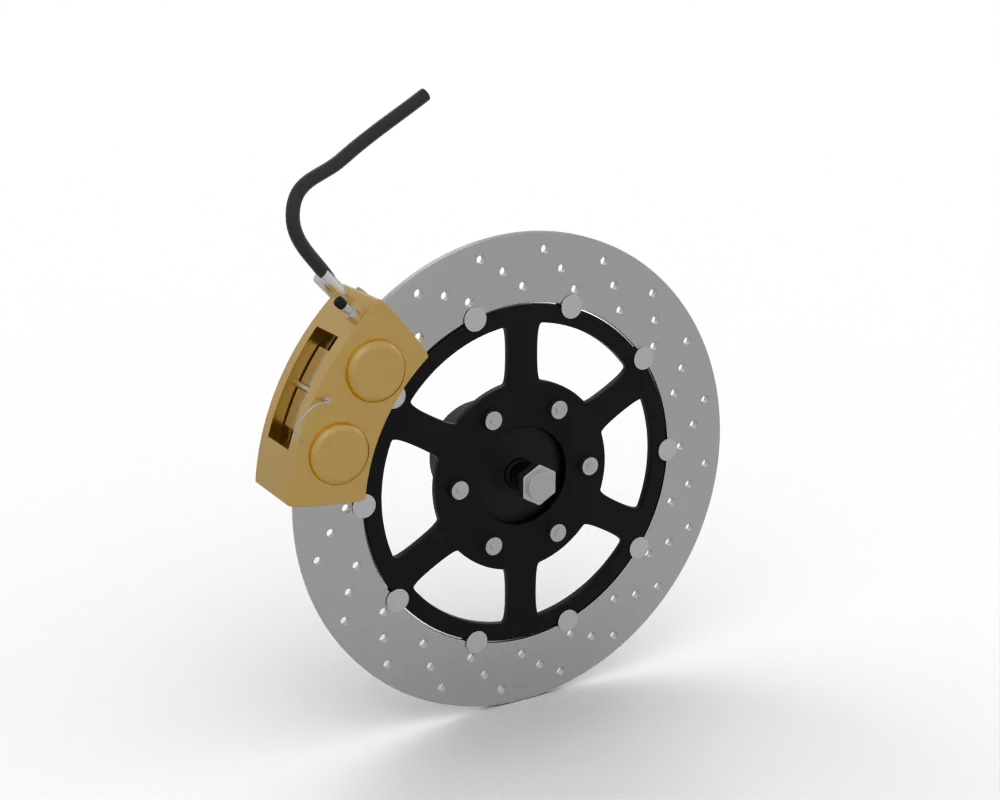
Braking is turning speed into heat
A moving motorcycle carries kinetic energy, and the brakes must turn all of it into heat. The energy rises with the square of speed, so doubling your speed quadruples the heat the brakes have to absorb. The course works this through for a K-Light 125 commuter (145 kg) with an 80 kg rider stopping from 90 km/h: about 70 kJ of energy has to go somewhere in a few seconds.
In a hard stop the front brake does roughly 70 per cent of the work, because weight transfers forwards onto the front tyre. If most of that heat goes into a 0.9 kg steel disc before it can escape, the disc warms by about 100 K in a single stop. Repeated stops from high speed, or a long mountain descent, take discs to 300 to 400 °C and push heat into the calipers and fluid. That is why pad compound and brake fluid boiling point matter so much.
Drum brakes
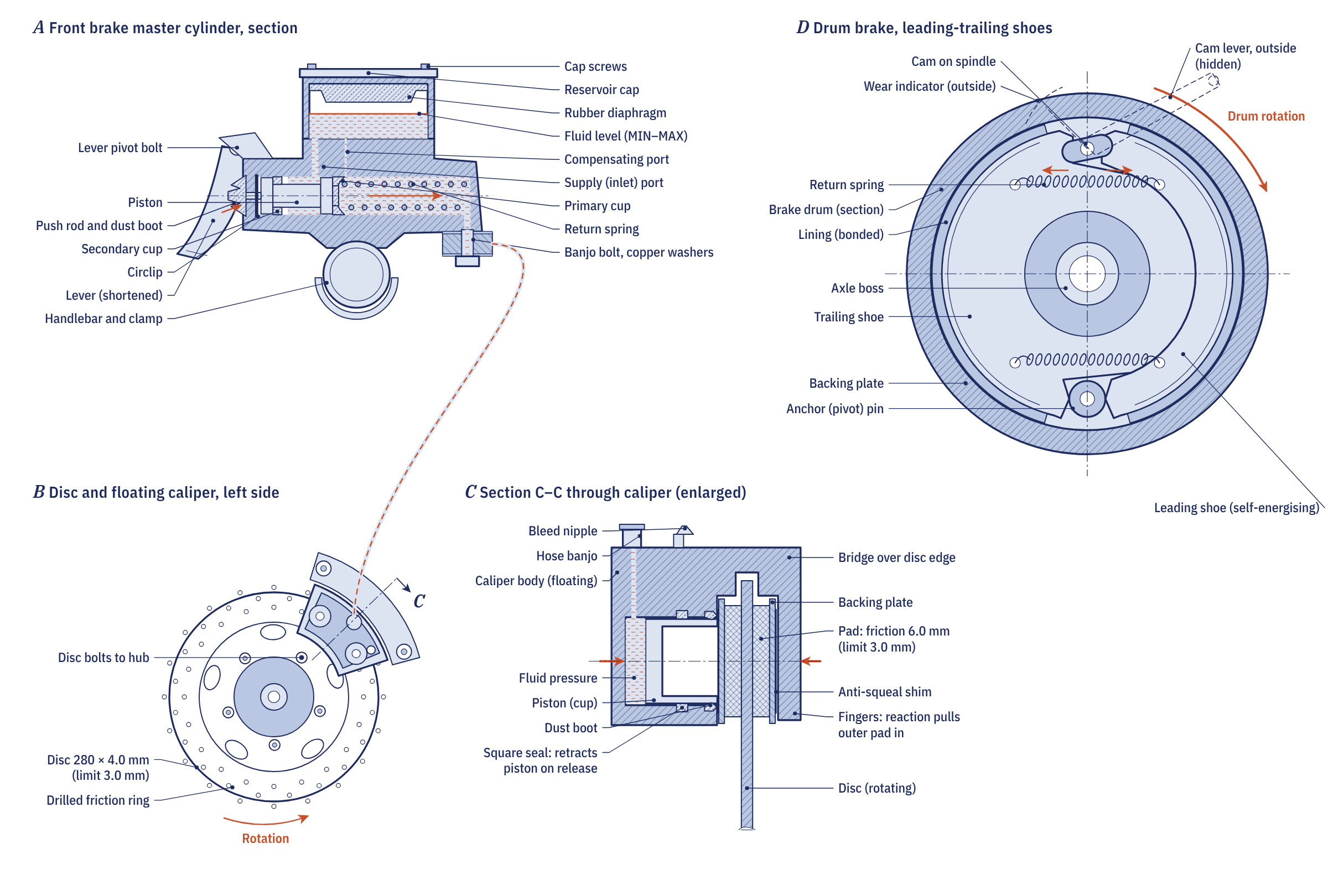
A drum brake has two curved shoes with bonded linings mounted on a backplate. Each shoe pivots on an anchor pin at one end; at the other, a flat cam turned by a cable or rod pushes the shoes apart against the inside of the drum, which is part of the wheel hub, and return springs pull them back when you let go.
In a single leading shoe brake, the leading shoe faces the direction of rotation, so friction drags it harder into the drum. This self-servo effect means that one shoe does roughly two-thirds of the braking. A twin leading shoe brake has two cams so that both shoes self-servo, which gives much stronger forward braking; it was fitted to sporting machines until discs replaced it in the 1970s. Drums are enclosed, cheap and resist water and mud, so the rear brake of many commuters and step-throughs is still a drum. Their weakness is heat: the drum expands away from the shoes as it gets hot, and the brake fades.
How a hydraulic disc brake multiplies force
A disc brake clamps a pair of pads onto a disc that turns with the wheel. The force comes from hydraulics. Pressure in a confined fluid is equal everywhere, so a small piston in the master cylinder at the lever creates the same pressure on the much larger pistons in the caliper. Force is multiplied in the ratio of their areas, and the lever multiplies it again.
Chapter 5.7 of the course gives a worked example: an 11 mm master cylinder, a lever ratio of 4:1, a 100 N squeeze and a floating caliper with two 27 mm pistons acting on a 280 mm disc, the size fitted to the K-Light 125. The hydraulic ratio is about 12 and the total ratio from hand to pads about 48:1, giving a clamp force of around 4,800 N and, from the front brake alone, a deceleration of about 0.7 g.
The price of multiplication is movement. The master cylinder has to push twelve times the volume of fluid that the pads take up, so a larger master cylinder gives a harder, less powerful lever and a smaller one a softer, more powerful lever with more travel. As the pads wear, the caliper pistons simply slide further out through their square-section seals, so a disc brake adjusts itself.
Calipers, discs and pads
- Floating (sliding) calipers have pistons on one side only; the body slides on greased pins so the reaction pulls the outer pad onto the disc. They are light and cheap and fitted to most small machines, including the K-Light 125. Seized slide pins cause uneven pad wear and drag.
- Fixed (opposed-piston) calipers have two, four or six pistons on both sides of a rigid body, giving more even pad pressure and higher stiffness. A radial mount bolts the caliper on in a stiffer direction so it flexes less under hard braking.
- Floating discs ride on bobbins so the friction ring can expand with heat without warping.
- Organic pads are quiet, kind to discs and bite well when cold, but fade at high temperature and wear quickly. Sintered pads work well wet and hot and last longer, but wear discs faster and must only be used on discs approved for them.
Our guide to checking brake pads and discs gives the K-Light wear limits: 3 mm of pad friction material and a front disc thickness of 3.0 mm.
Brake fluid and brake fade
Most brake fluids (DOT 3, DOT 4 and DOT 5.1) are glycol-based and hygroscopic: they absorb water from the air through the seals and reservoir vent, and their boiling point falls sharply as they do. DOT 4, the fluid the K-Light uses, must boil no lower than 230 °C when new but only 155 °C once it has absorbed 3.7 per cent water. Silicone DOT 5 must never be mixed with the glycol fluids.
Fade is the loss of braking as the system overheats, and it comes in two kinds. Pad fade happens when the friction material passes its working temperature and the lever stays firm but the bike stops slowing. Fluid fade happens when old, wet fluid boils in a hot caliper: vapour bubbles compress, and the lever can suddenly travel to the bar. Replacing glycol fluid every two years, the usual maker's interval, is the cheapest protection against it.
Combined braking (CBS)
A combined braking system applies both brakes from one control, so a rider who uses only the rear pedal, which is common on commuters, still gets some front braking. On the K-Light 125 the system is hydraulic: the rear pedal feeds the rear caliper and, through a small secondary master cylinder called the CBS pump, one piston circuit of the front caliper. The handlebar lever works the front brake alone. Many scooters use a mechanical CBS instead, with an equaliser link on the left lever that pulls both brake cables.
ABS: stopping without locking a wheel
An anti-lock braking system watches each wheel through a speed sensor reading a toothed tone ring on the hub or disc carrier. When the ECU sees a wheel slowing much faster than the motorcycle, it closes a valve in the hydraulic modulator to hold the pressure, opens another to release a little fluid, and a pump returns that fluid, cycling several times a second until the tyre grips again. The rider feels it as pulsing at the lever. BMW offered the first production motorcycle ABS on the K100 in 1988. Cornering ABS adds an inertial measurement unit that measures lean angle, so the system builds pressure more gently when the bike is leaned over.
Rules now require these systems on new machines. In the European Union, motorcycles above 125 cc must have ABS, and 125 cc models must have ABS or CBS. India requires ABS above 125 cc and CBS or ABS at or below 125 cc on all new two-wheelers from April 2019. When an ABS warning light stays on, the usual causes are a damaged tone ring, a sensor gap out of specification, a dirty sensor, mismatched tyre sizes or low battery voltage.
Go deeper
- Chapter 5.7: Brakes: energy, hydraulics, CBS, ABS and the job sheets
- Equations summary: kinetic energy, disc temperature, line pressure, clamp force and brake torque
- 3D model: disc brake with radial caliper: turn it round in the model library
- Drivetrain and chassis quiz: test yourself on Module 5
- Bleeding a hydraulic brake
- Brake fluid check
- Combined brake check
- Brakes fade when hot
- ABS warning light on
Frequently asked questions
What is the difference between disc and drum brakes on a motorcycle?
A drum brake pushes two shoes outwards against the inside of a drum in the wheel hub; a disc brake clamps pads onto a disc using hydraulic pressure. Discs shed heat better and fade less, while drums are cheap, enclosed and still common on the rear of commuters.
What is brake fade?
Fade is a loss of braking as the brakes overheat. Pads can pass their working temperature, a drum can expand away from its shoes, and old brake fluid can boil so that the lever goes soft. Fresh fluid and the right pads reduce it.
How often should motorcycle brake fluid be changed?
Glycol fluids such as DOT 4 absorb water and lose boiling point over time, so the usual interval is every two years. Never reuse fluid or use fluid from a container that has stood open for a long time.
What is CBS on a motorcycle?
A combined braking system works both brakes from one control. On the K-Light 125 the rear pedal also operates part of the front caliper through a small CBS pump, so a rider who uses only the pedal still gets front braking.
How does motorcycle ABS work?
Wheel speed sensors tell the ECU when a wheel is about to lock. The ABS modulator then holds and releases brake pressure several times a second until the tyre grips again, which the rider feels as pulsing at the lever.
Written by Transitions Lab for the Motopedia open motorcycle course. Text and illustrations are licensed CC BY-SA 4.0. Figures and values come from the course modules; see sources and credits.