
Why an engine needs cooling
A small air-cooled four-stroke turns at best about 28 to 32 per cent of its fuel's energy into work. Much of the rest leaves through the exhaust, and about a third leaves through the cylinder walls and head. If that heat is not carried away, the oil thins and breaks down, the piston expands until it scuffs the bore, and the mixture starts to detonate. Every engine therefore needs a way to move heat from the hot metal around the combustion chamber into the air. The three common answers are fins, oil and coolant.
Air cooling: fins and airflow
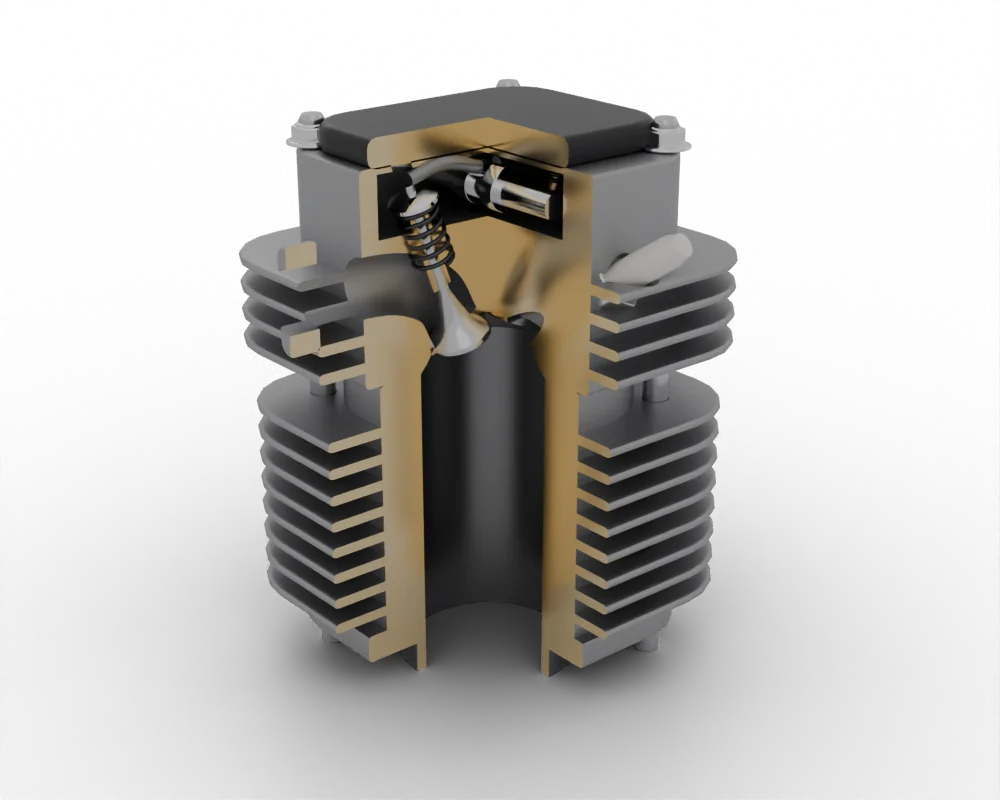
An air-cooled cylinder and head carry fins, which multiply the surface area exposed to the passing air. The fins are deepest around the exhaust port and combustion chamber, where the heat flow is highest. There is no pump, radiator, hose or coolant to fail, which makes air cooling light, cheap and easy to repair where parts are scarce. It suits the K-Light 125 and almost every commuter single.
The drawback is that the engine's temperature varies more with speed, load and weather. Its working clearances must be larger and its compression lower: the air-cooled K-Light runs 9:1. Mud packed between the fins or broken fins cut the cooling, and the result is overheating, detonation and in the end seizure. Riding slowly in heavy traffic on a hot day is the hardest test an air-cooled engine faces, because the airflow that cools it depends on road speed.
Oil cooling and oil-air cooling
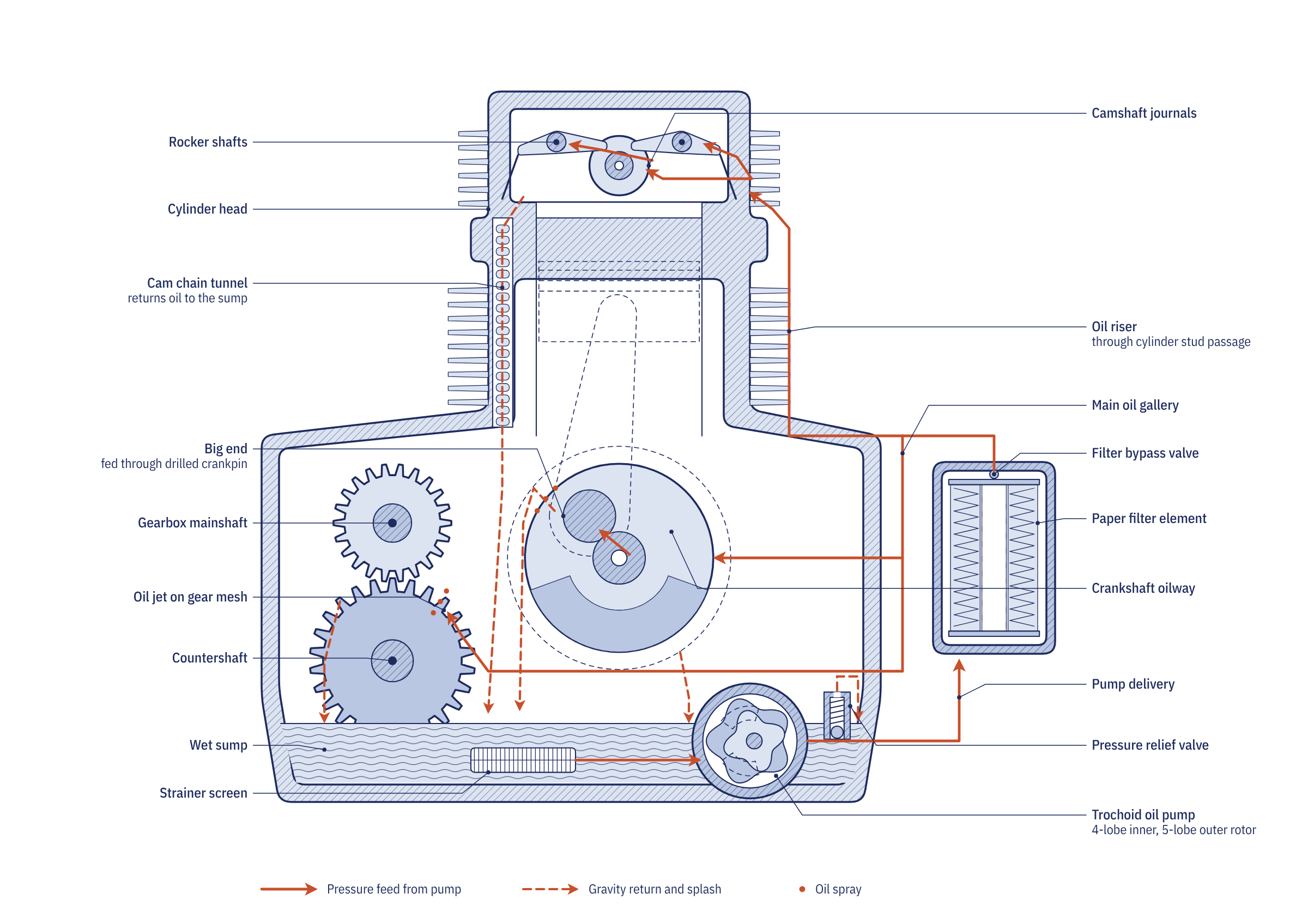
Every four-stroke's oil carries some heat away from the parts it lubricates: the piston underside, the big end, the cam and the valve gear. On an air-cooled engine the oil may carry 20 to 30 per cent of the heat the engine rejects. Many larger air-cooled engines take advantage of this by adding an oil cooler, a small radiator through which the oil is pumped before it returns to the engine. Others go further and spray or route oil through passages in the cylinder head, as Suzuki did on its SACS engines.
The course describes oil-air cooling as an intermediate solution: it keeps the simplicity of an engine without water jackets, pump or coolant, while holding the head and oil at a steadier temperature than fins alone. It makes the oil level and grade even more important, because the oil is now part of the cooling system. On any air-cooled or oil-cooled engine, low oil is one of the first things to check when it overheats.
Liquid cooling: pump, radiator, thermostat and cap
A liquid-cooled engine has water jackets cast around the cylinder and combustion chamber. A centrifugal water pump, driven by the crankshaft or camshaft, circulates coolant through the jackets to a radiator at the front of the motorcycle, where the passing air carries the heat away.
- A wax-element thermostat keeps the coolant inside the engine until it reaches about 80 to 85 °C, then opens progressively, so the engine warms up quickly and runs at a steady temperature.
- An electric fan, switched by a thermo-switch or the ECU at about 95 to 105 °C, pulls air through the radiator when the bike is moving slowly or standing in traffic.
- The pressure cap holds the system at typically 0.9 to 1.4 bar above atmospheric. Boiling point rises with pressure, so a 50 per cent glycol mixture that boils at about 107 °C in an open pan will not boil until about 125 to 130 °C under the cap.
Holding the cylinder and head at about 80 to 100 °C lets the designer use tighter clearances, compression ratios of 11 to 13:1 and much higher power for the size, which is why liquid cooling is normal on sports bikes, larger twins and multis. The cost is the extra weight and parts: pump, radiator, thermostat, hoses and coolant, all of which can leak or fail.
Coolant and the pressure cap
Motorcycle coolant is glycol with aluminium-safe corrosion inhibitors, mixed 50:50 with deionised water, which protects against frost down to about −35 °C. The inhibitors wear out, so the coolant is replaced every two to three years. A cap with a weak seal or spring lets coolant boil, foam and escape to the overflow tank. Bubbles rising steadily in the header tank at idle point to a failed head gasket or cracked head pushing combustion gas into the coolant; a combustion leak tester that detects CO₂ confirms it.
Never open a radiator cap on a hot engine. The coolant is above its atmospheric boiling point and flashes to steam the moment the pressure is released, causing severe scalds. Wait until the engine is cold, then release the cap slowly to its first stop.
The three systems compared
| Air-cooled | Oil-air cooled | Liquid-cooled | |
|---|---|---|---|
| How heat leaves | Fins on cylinder and head | Fins plus oil through a cooler or the head | Coolant through jackets and a radiator |
| Extra parts | None | Oil cooler and lines | Pump, radiator, thermostat, fan, hoses, coolant |
| Temperature control | Varies with speed and weather | Steadier | Held by the thermostat |
| Typical compression | Lower (9:1 on the K-Light 125) | In between | 11 to 13:1 |
| Typical use | Commuters, classics, many cruisers | Larger air-cooled engines | Sports bikes, larger twins and multis |
When an engine overheats
On an air-cooled engine, check the oil level first, then look for blocked or broken fins and a lean mixture, which burns hotter. On a liquid-cooled engine, check the coolant level when cold, then the fan, the thermostat and the radiator: a thermostat stuck shut stops coolant reaching the radiator and the engine overheats quickly, while one stuck open makes it run cold, with poor economy and more wear. A blocked radiator, full of mud or bent fins, has the same effect as a failed fan.
Electric motorcycles need cooling too. Hub motors and small mid-drive motors are air cooled by fins on their housings, while larger mid-drives use a liquid jacket shared with the controller. Our article on how electric motorcycles work explains where that heat comes from.
Go deeper
- Chapter 2.6: Lubrication and cooling: oil circuits, oil grades, air and liquid cooling
- Chapter 1.2: Types and configurations: air versus liquid cooling in the choice of engine
- Equations summary: boiling point against cap pressure
- Engine quiz: test yourself on Module 2
- Air cooling check: fins, oil and airflow
- Coolant check
- Thermostat test
- Cooling fan test
- Air-cooled engine overheats
- Liquid-cooled engine overheats
Frequently asked questions
Is liquid cooling better than air cooling on a motorcycle?
Liquid cooling holds the engine at a steady temperature, which allows tighter clearances, higher compression and more power for the size. Air cooling is lighter, cheaper and has nothing to leak, which is why it still suits commuters and classic designs.
What is an oil-cooled motorcycle engine?
It is an air-cooled engine that also uses its oil to carry heat away, usually through an oil cooler and sometimes through passages in the cylinder head. It sits between air and liquid cooling in complexity and temperature control.
Can an air-cooled motorcycle overheat in traffic?
Yes. Its cooling depends on airflow, so long periods at walking pace on a hot day are its hardest test. Low oil, packed or broken fins and a lean mixture all make it worse.
Why should I never open a hot radiator cap?
The coolant is under pressure and above its normal boiling point. Releasing the cap lets it flash to steam and spray out, which can cause severe scalds. Wait until the engine is cold.
How often should motorcycle coolant be changed?
Every two to three years, because the corrosion inhibitors wear out. Use an aluminium-safe glycol coolant mixed 50:50 with deionised water, or a premixed coolant to the maker's specification.
Written by Transitions Lab for the Motopedia open motorcycle course. Text and illustrations are licensed CC BY-SA 4.0. Figures and values come from the course modules; see sources and credits.