
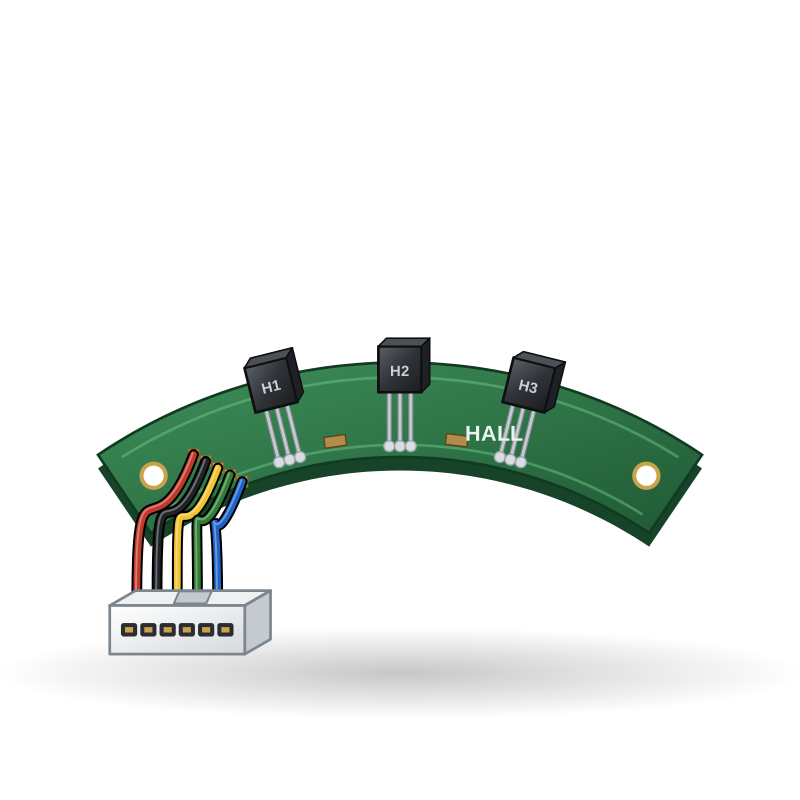
The motor position sensor tells the controller where the motor's magnets are. In most commuter hub motors it is a set of small Hall effect sensors glued into the stator inside the motor. Some motors use a resolver or encoder instead. A thin multi-wire cable runs with the phase wires out through the axle.
What it does
Each Hall sensor switches its output high or low as a magnet passes. From these signals the controller knows which winding to power next, so the motor starts smoothly and turns in the right direction. If one sensor fails or a sensor wire breaks, the controller gets the timing wrong. The motor may judder, growl, pull weakly, run only after a push, or not start, and the controller may show a sensor error.
Signs it is worn or failing
- Judder or shake when pulling away: Bike judders when pulling away.
- Growling or rough motor: Noise from the motor.
- Ready but no drive, or drive only after a push: Bike shows ready but will not move.
- Sensor fault code: Error code on the dashboard.
- After water: Bike has been in a flood.
When to replace it
Check the sensor connector and cable first; damage where the cable leaves the axle is common. Sensors inside the motor are replaced only by a workshop that can open the motor safely; the magnets are very strong.
What to match when buying
- The exact sensor type for the motor (Hall sensor part code, or resolver model). Sensor spacing in the motor must match what the controller expects.
- Buy as part of a motor service kit from the maker where possible.
Fitting notes
- Workshop job: Check motor position (Hall) sensors.
- Also check phase connectors: Check motor phase connectors.
- Isolate first: Make an electric motorcycle safe to work on.