
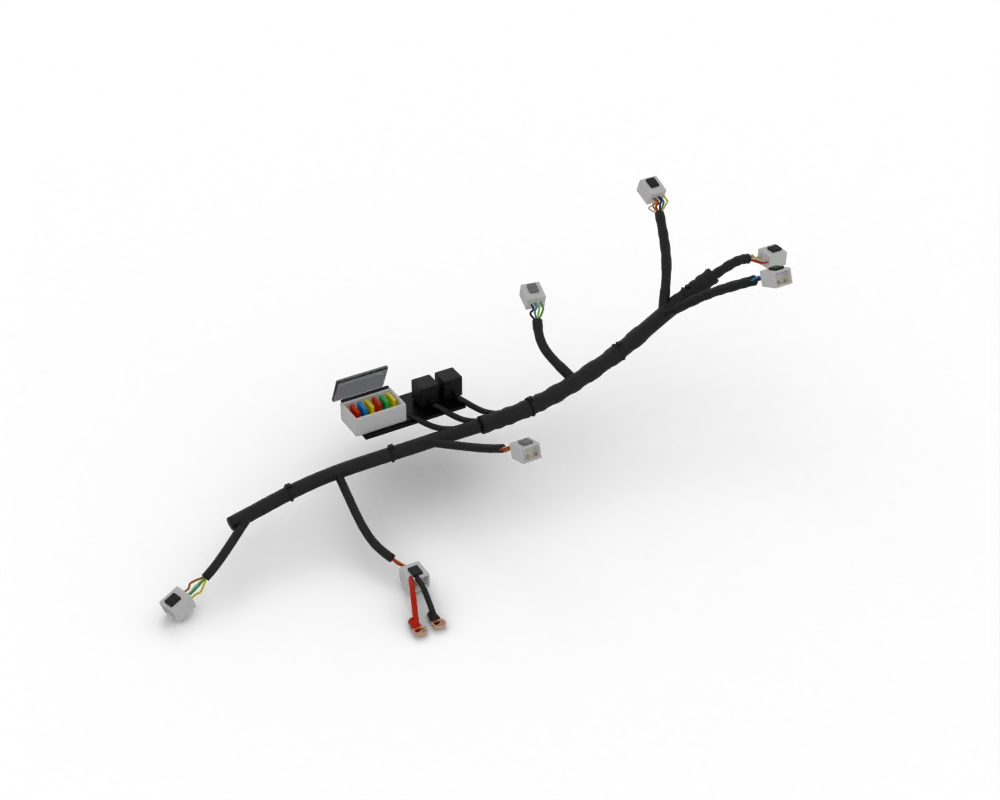
What the harness is
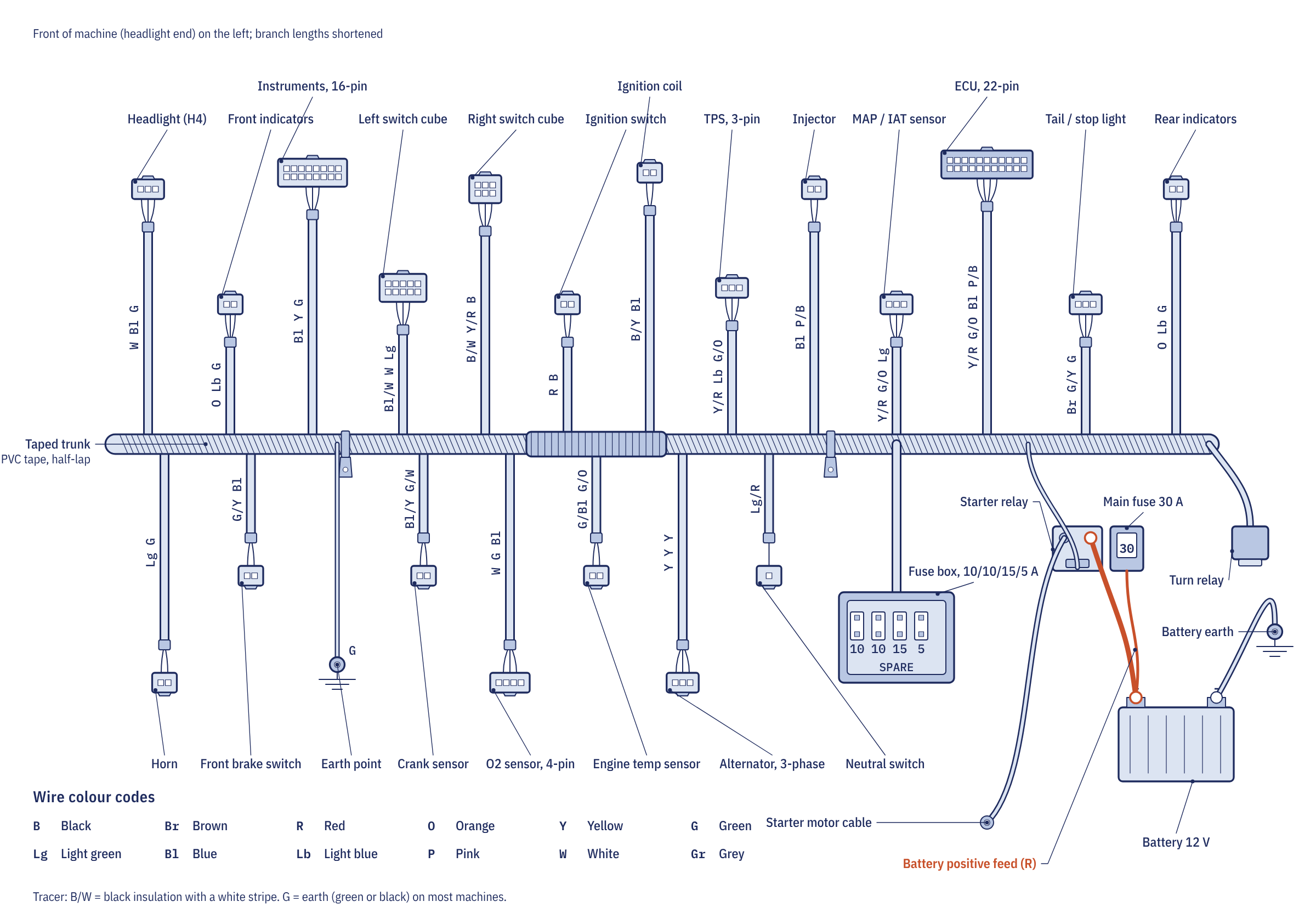
The wiring harness is a bundle of colour-coded wires, wrapped together into a trunk that runs along the frame, with branches to every electrical component. It connects the battery, the charging system, the starter, the ignition and engine management, the lights, the horn and the instruments. Each branch ends in a multi-pin connector, and the fuse box and relays are usually plugged into the harness near the battery.
Single-wire earth return
Most motorcycles use a single-wire earth-return system. The battery negative terminal is connected to the frame and engine, and each load returns its current either through the metal structure or through a black earth wire to a common earth point. Modern machines run dedicated earth wires to electronic parts, because painted, plastic and rubber-mounted parts do not give a reliable path, and because a few tenths of a volt of difference between earth points corrupts sensor signals. A corroded earth is one of the most common causes of dim lights and strange intermittent faults.
Fuses protect the wiring
A fuse protects the wire, not the component. It must be rated below the current that the smallest wire in its circuit can carry. Blade fuses of 10 A and 20 A are typical: the K-Light 125 used as the course example has a 20 A main fuse and two 10 A branch fuses. A fuse that blows repeatedly means there is a short circuit downstream. Fitting a larger fuse never fixes that and can set the harness alight.
Wire colour codes
Wire colours follow the manufacturer's code, with a stripe colour written after a slash. On the K-Light 125 diagram, R (red) is battery positive, R/W (red with a white stripe) is the switched supply after the ignition switch, B (black) is earth, and the three white wires are the alternator phases. Japanese makers use similar abbreviations, but they do not always mean the same thing, and many use yellow for the alternator phases. The colour key printed on the wiring diagram for the exact model is the only reliable authority.
| Code | Colour | Code | Colour |
|---|---|---|---|
| B | Black | R | Red |
| BL | Blue | LR | Pink |
| LBL | Light blue | W | White |
| N | Brown | P | Purple |
| G | Green | Gr | Grey |
| O | Orange | DG | Dark green |
| Y | Yellow |
The charging circuit
An alternator on the end of the crankshaft makes alternating current. On almost all small motorcycles it is a permanent-magnet type: a rotor carrying magnets spins around a stator of copper coils. Its output rises with engine speed, and a typical three-phase stator can produce 50 to 80 V AC at 5,000 rpm with no load, so it must be controlled.
The regulator/rectifier turns that AC into DC through a diode bridge and holds battery voltage in a safe window, generally 13.5 to 15.0 V at 5,000 rpm on a lead-acid system. The K-Light 125 specifies 14.5 ± 0.5 V. Too low and the battery slowly goes flat; too high and the battery dries out and bulbs blow. Traditional shunt regulators short the surplus current to earth as heat, which is why they carry large fins and why stators on small bikes can fail from overheating. Series (MOSFET) regulators disconnect the stator instead and run much cooler.
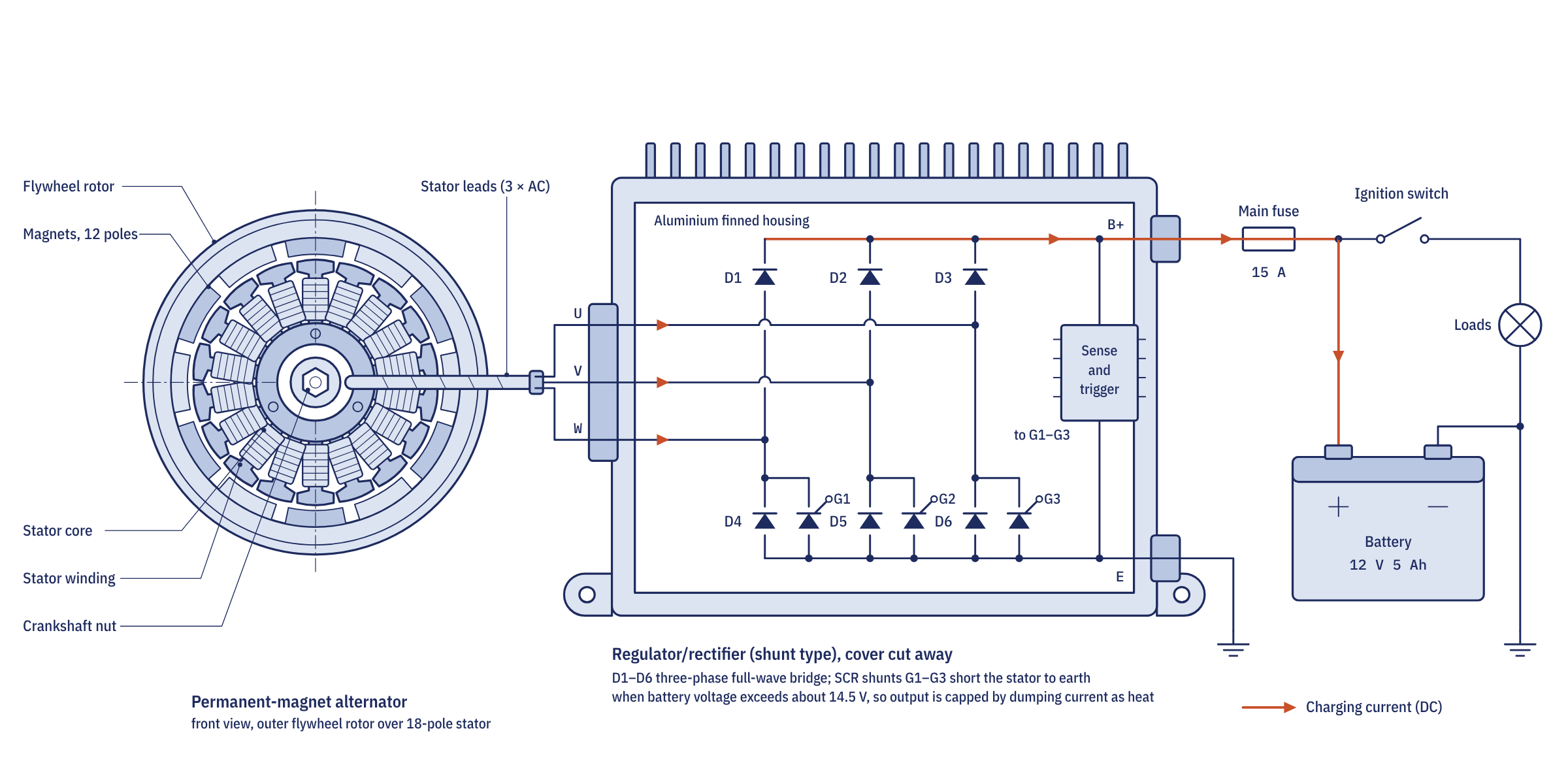
A quick health check needs only a multimeter. A rested flooded lead-acid battery reading about 12.7 V is fully charged and one reading 12.2 V is half charged; sealed AGM batteries read a little higher, about 12.8 to 13.1 V when full. With the engine held at about 5,000 rpm, the voltage across the battery should rise into the specified charging window.
The starting circuit
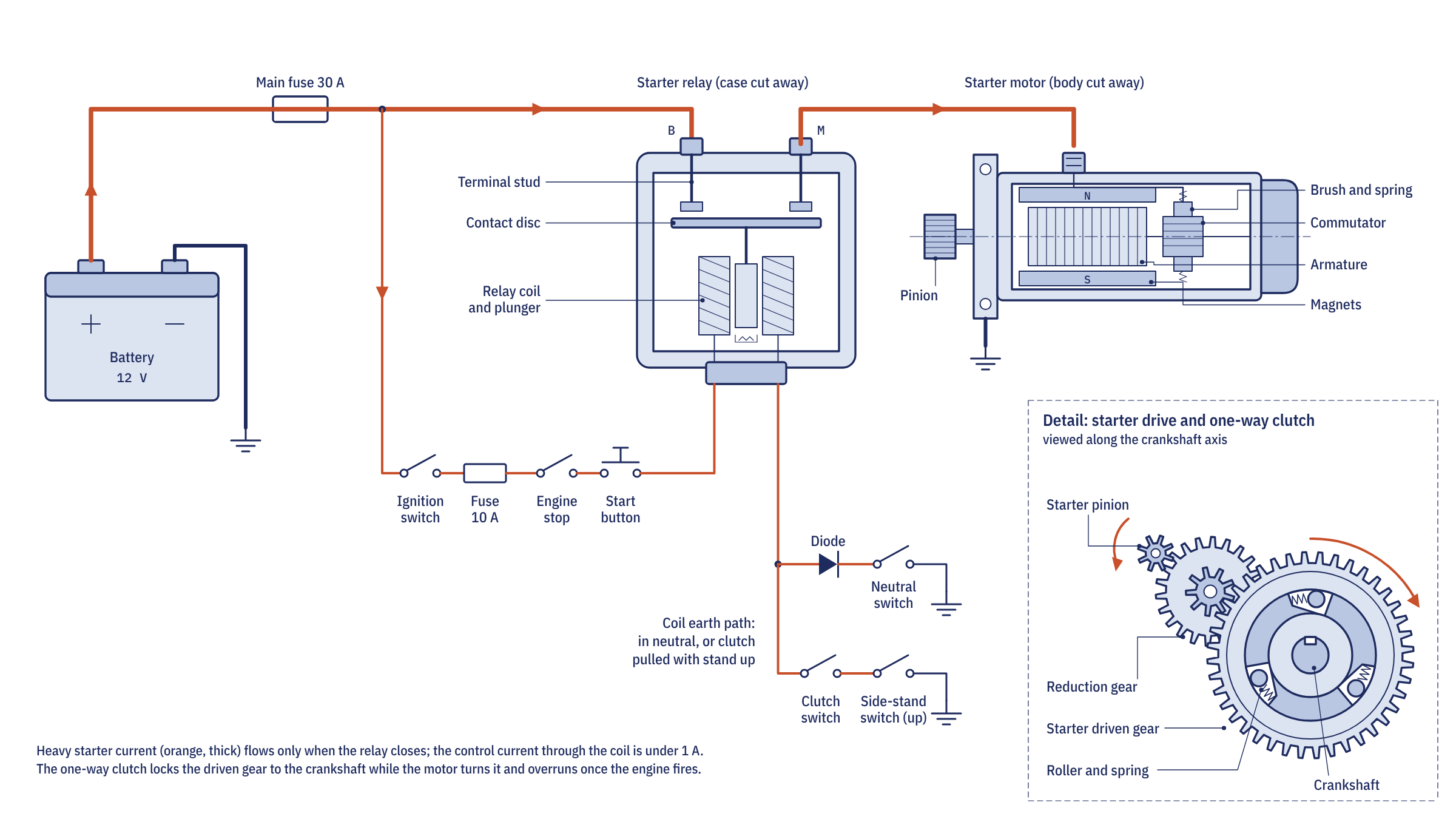
An electric starter motor draws tens to over a hundred amps, far more than a handlebar switch can carry. So the start button only energises the coil of a starter relay, which uses a few hundred milliamps and switches the heavy cable from battery to motor. The relay coil circuit runs through a chain of safety interlocks: the neutral switch, the clutch switch, the side-stand switch, the engine stop switch and, on many scooters and on the K-Light 125, a brake lever switch. If any of them is open, the starter will not turn, which is the first thing to check when the starter is silent.
How to trace a wiring fault
- Find the component that does not work, for example the brake light, and identify which of its wires is supply and which is earth.
- Trace the supply back on the diagram through each switch, connector and fuse to the ignition switch and battery, writing down every colour change.
- List every other circuit that shares the same fuse. If the horn and the brake light fail together, the shared fuse is the first suspect.
- Trace the earth path back to the battery negative or its earth point.
- Choose a test point near the middle of the circuit, so one voltage reading tells you which half the fault is in, and repeat.
Most faults are mechanical rather than electrical: corroded or loose terminals, pins pushed back out of a connector by careless probing, and wires chafed where the harness passes the steering head. Repairs should use crimped terminals of the right type, or a soldered and heat-shrunk splice. Larger modern machines also link their control units over a two-wire CAN bus, which is tested differently; chapter 3.5 of the course, Lighting, signalling and wiring, covers it, and chapter 3.4, Battery, charging and starting, gives the full charging and starting tests. For a battery that keeps going flat, our guide to battery, charging and drain tests takes you through them in order, and the Repair section's wiring and battery pages list common electrical faults.
Frequently asked questions
What voltage should a motorcycle battery read?
A rested 12 V flooded lead-acid battery reads about 12.7 V when fully charged and about 12.2 V at half charge; a sealed AGM battery reads about 12.8 to 13.1 V when full. With the engine at about 5,000 rpm the charging voltage is usually 13.5 to 15.0 V.
What colour is the earth wire on a motorcycle?
Black is the usual earth colour, including on the K-Light 125 diagram. Always confirm with the colour key on the wiring diagram for your model.
Why does my motorcycle starter not turn when I press the button?
Check the interlocks first: neutral, clutch lever, side stand, engine stop switch and, on many bikes, the brake lever. Then check the battery voltage, the main fuse and the starter relay.
Can I fit a bigger fuse if mine keeps blowing?
No. A fuse that keeps blowing shows a short circuit downstream. A larger fuse lets the wiring overheat instead of protecting it.
Written by Transitions Lab for the Moto Zero open motorcycle course. Text and illustrations are licensed CC BY-SA 4.0. Figures and values come from the course modules; see sources and credits.