
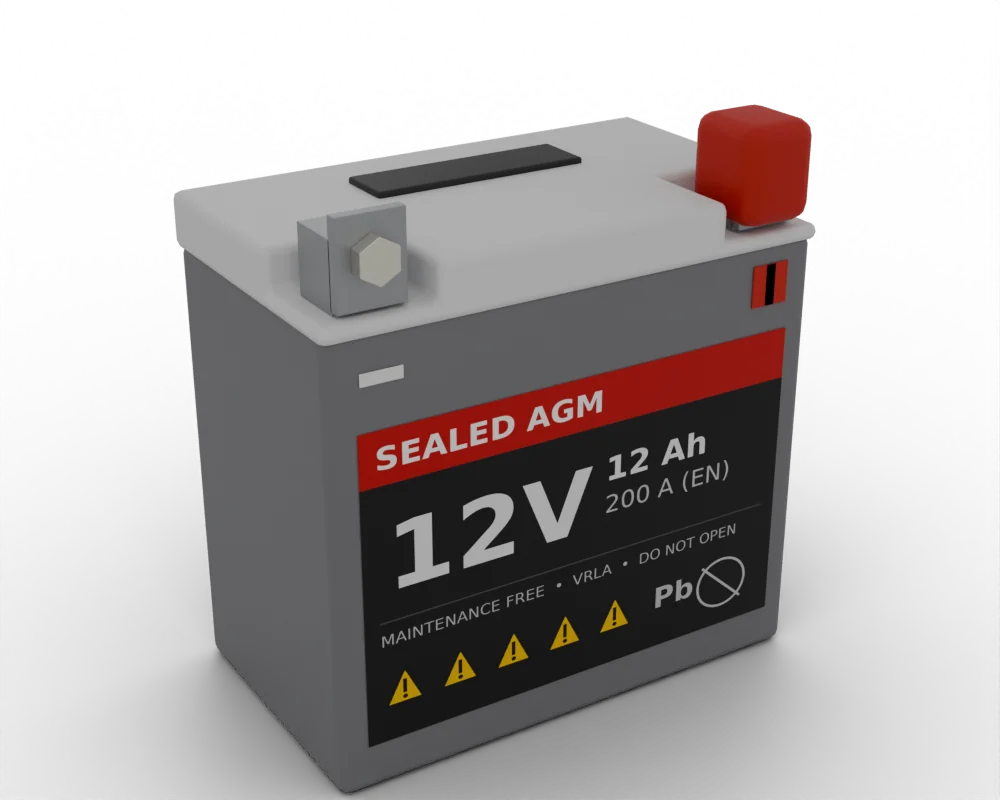
Three causes, three tests
Test in this order, because each test depends on the one before. A charging test on a flat battery gives a misleading result, and a drain test is pointless if the battery cannot hold charge anyway.
- The battery: is it sulphated, damaged or simply worn out?
- The charging system: do the alternator and regulator/rectifier put charge back in while you ride?
- Parasitic drain: is something drawing current with the key off?
Test 1: the battery
Look at the case first. A swollen AGM battery has been overcharged and must be replaced. Then measure the open-circuit voltage after the battery has rested for at least an hour, so that the surface charge left by riding or charging has gone.
| State of charge | Flooded lead-acid | AGM |
|---|---|---|
| 100 % | 12.65 to 12.7 V | 12.8 to 13.1 V |
| 75 % | 12.4 V | 12.6 V |
| 50 % | 12.2 V | 12.3 V |
| 25 % | 12.0 V | 12.0 V |
| Flat | 11.8 V or less | 11.8 V or less |
The K-Light 125 manual, used as the worked example in the Moto Zero course, gives 13.1 V for its 6 Ah AGM battery fully charged and 12.3 V as the point where it needs charging. Charge at no more than 10 per cent of the ampere-hour rating: 0.6 A for 10 to 15 hours for a 6 Ah battery. Wait 30 minutes after charging and measure again: 12.8 V or more means the charge is complete.
Then check whether it holds. A good battery loses less than about 0.1 V over 24 hours of rest, and during cranking it should stay above about 9.6 V. A battery that reads below about 11.8 V even after a full charge has a failed cell. A battery left partly discharged grows hard sulphate crystals on its plates, which permanently reduce capacity; the K-Light manual notes that capacity typically declines after 2 to 3 years.
Charging releases hydrogen, which is explosive. Charge in a ventilated area, switch the charger off before connecting or disconnecting the clips, and wear eye protection. When removing a battery, disconnect the negative first; when refitting, connect the positive first and the negative last.
Test 2: the charging system
With a fully charged battery, warm the engine, connect the multimeter on DC volts across the battery terminals and raise the engine speed slowly to 5,000 rpm. The voltage should rise to 14.0 to 15.0 V and then stop rising. Switch the headlight to main beam: the reading may fall slightly but should stay above 13.5 V. The K-Light 125 specification is 14.5 ± 0.5 V at 5,000 rpm.
- Voltage stays at battery voltage: no charge is reaching the battery. Suspect the stator, the regulator/rectifier or the wiring between them.
- Voltage rises above 15.0 V: the regulator is not limiting, or its earth is poor. Overcharging dries out AGM batteries and blows bulbs.
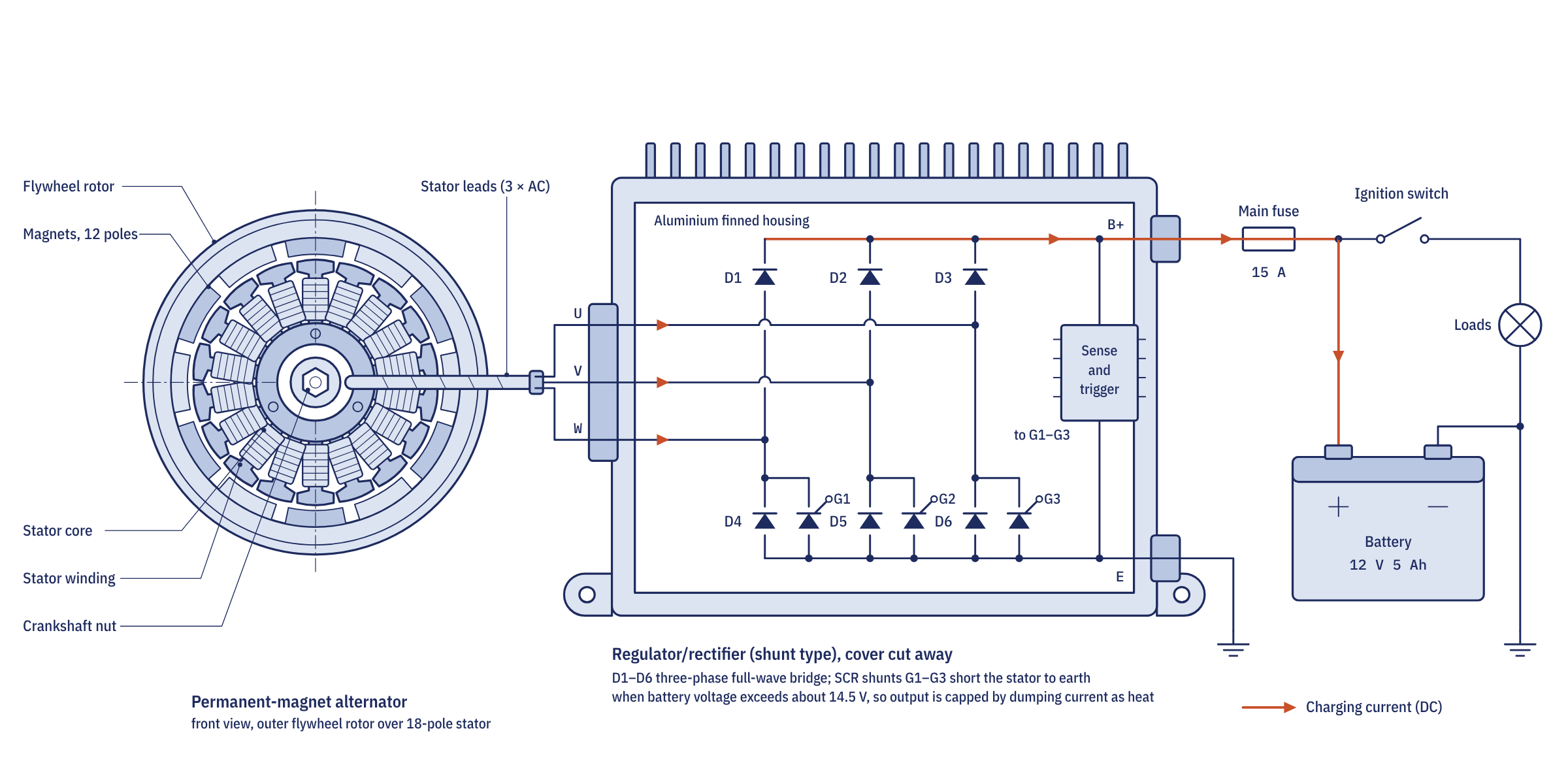
To go further, stop the engine and unplug the stator connector. On the K-Light, each pair of the three white stator wires should measure 0.8 ± 0.3 ohms, and there must be no continuity from any white wire to the engine. With the engine running and the connector still unplugged, the AC voltage between each pair should be equal within about 10 per cent, typically 50 to 80 V AC on a small three-phase stator. One low pair confirms a stator fault.
Most small motorcycles use a shunt regulator, which dumps surplus current as heat. Shunt regulators and stators run hot, and a corroded regulator connector overheats and melts, so look for discoloured plugs. On a small single the alternator output is only just larger than the load with the lights on, which is why long periods of idling with the headlight on can drain a healthy battery.
Test 3: parasitic drain
With the key off, the ECU memory, a clock or an alarm may draw a small current permanently. The K-Light fault tree allows no more than 1 mA. To measure it, disconnect the battery negative and connect an ammeter in series between the negative terminal and the negative lead. Start on the 10 A range to survive any wake-up surge, then step down to the milliamp range once the reading settles; modern ECUs can take several minutes to go to sleep. Never connect an ammeter directly across the battery terminals.
If the drain is too high, pull the fuses one at a time until it drops, which identifies the circuit. The K-Light tree checks the brake light switch first, because a switch stuck on is a frequent cause. The size of the drain matters: the course calculates that a 20 mA accessory alarm would take a 6 Ah battery to half charge in about six days.
Lithium batteries
Lithium iron phosphate (LiFePO4) starter batteries are light and hold their charge well in storage, but they need different care. They must never be charged on a desulphation or pulse mode, must not be held above about 14.6 V, and must not be charged below about 0 °C. Their voltage barely changes between 20 and 80 per cent charge, so the voltage table above does not apply. Fit one only when the charging system regulates within the battery maker's window.
Storage and prevention
A stored battery discharges itself. The K-Light manual asks for a charge about every three months in storage; a smart charger with a float stage at about 13.5 to 13.8 V can stay connected. Keep the terminals tight and lightly coated with petroleum jelly, and avoid jump-starting from a running car, which exposes the motorcycle's electronics to voltage spikes.
The battery page in the Repair section collects these tests with the related faults, and the wiring page covers the connectors and earths that cause many charging problems. Our wiring basics guide explains how to read the circuit, and chapter 3.4 of the course, Battery, charging and starting, gives the full job sheets.
Frequently asked questions
Why does my motorcycle battery die overnight?
Usually a parasitic drain: a brake light switch stuck on, an accessory or alarm, or a faulty circuit. Measure the current with the key off; the K-Light 125 allows no more than 1 mA.
What voltage should a motorcycle charging system show?
Typically 14.0 to 15.0 V across the battery at 5,000 rpm, staying above 13.5 V with the headlight on. The K-Light 125 specification is 14.5 ± 0.5 V.
How do I know if my motorcycle battery is bad?
Charge it fully, let it rest, and measure: below about 11.8 V after charging means a failed cell, and a loss of more than about 0.1 V in 24 hours or cranking voltage below about 9.6 V means it no longer holds charge.
What charging current should I use for a motorcycle battery?
No more than 10 per cent of the ampere-hour rating. A 6 Ah battery is charged at 0.6 A for 10 to 15 hours.
Written by Transitions Lab for the Moto Zero open motorcycle course. Text and illustrations are licensed CC BY-SA 4.0. Figures and values come from the course modules; see sources and credits.