
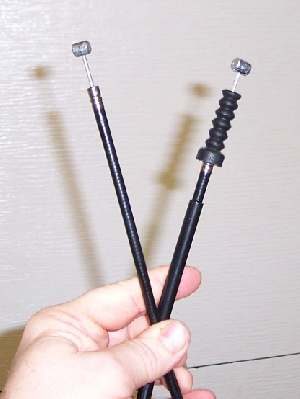
Factory cable ends are steel, pressed (swaged) onto the wire by a machine. At home the end is soldered on instead. Repair ends are brass and take solder well. A soldered end is a get-home or custom repair. For a throttle or front brake cable, a new factory cable is the safer choice.
Safety
- A throttle or brake cable whose end pulls off can cause a crash. Test the joint hard before you ride.
- Hot solder and flux spit. Wear eye protection and work on a clear bench.
You need
- A brass end that matches the old one in shape and in hole size for the wire.
- Flux, solder and enough heat to melt the solder through the whole end.
Steps
- Heat the solder pot (or iron) fully before you start.
- Compare the old cable with the new end. Check the end will fit the lever or grip in the same way.
- Measure the exposed inner wire on the old cable: the distance from the end of the outer to the end of the fitting. Write it down.
- Cut the frayed end off the wire cleanly. Slide the new end on.
- Cut the wire so a very short tail sticks out past the end. The cable hints sheet gives about 1/16 inch (about 1.5 mm).
- Tap the tail with a small hammer so it spreads (peen it) over the end of the fitting. This locks the wire and is the key to a strong joint.
- Dip the fitting in flux until it is covered.
- Dip it in the solder for about 10 seconds so the heat goes right through. Dip only just past the fitting: solder that runs up the wire makes it stiff and it breaks where it should flex.
- Let it cool without moving it. Wipe off the flux.
Check your work
- Pull hard on the end with pliers while holding the wire in a vice. It must not move.
- The wire just above the end still bends freely.
- Fit the cable and set free play: Adjust clutch lever free play or Adjust throttle free play.
If it did not fix the problem
- Outer cracked or inner stiff all along: fit a new cable (Replace the clutch cable, Lubricate or replace the throttle cable).