
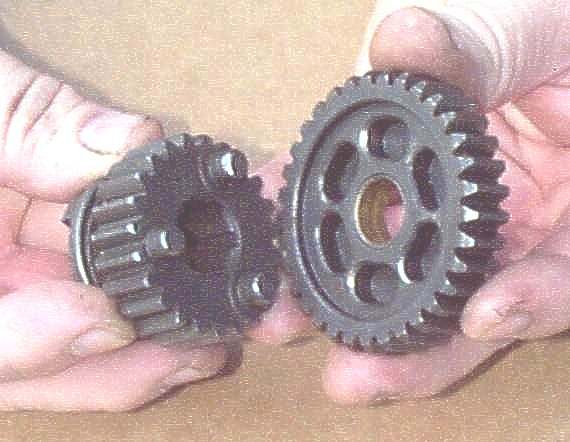
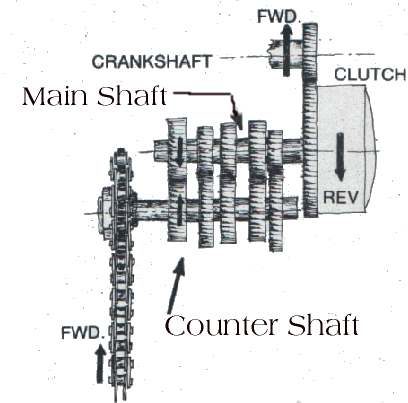
A motorcycle gearbox has two main shafts. The main shaft takes drive from the clutch. The countershaft carries the front sprocket (or output) at one end. Pairs of gears on the two shafts give the gear ratios.
What it does
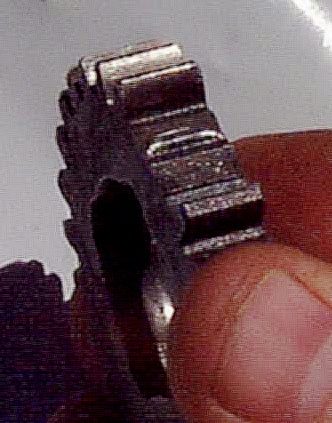
All gears are in constant mesh, so they are always spinning. Some gears are fixed to a shaft or machined as part of it. Others slide along the shaft or spin freely on it. Sliding gears carry dogs, which are knobs of metal that fit into slots in the gear beside them and lock it to the shaft. A shift fork moves the sliding gear. When a gear is locked, power flows through that pair to the output.
Signs it is worn or failing
- Whine in some gears or loud noise. Broken teeth are normally noisy.
- If there is much noise but no broken tooth is found, look for a bent tooth or a bit of debris stuck on a tooth.
- Jumps out of gear under power, usually second: look at the dogs and their slots for rounding.
- Stuck in gear or a gear that is missing. A bike can sometimes run with one gear missing, but a broken piece may jam in the box and lock everything. That is a real risk.
When to replace it
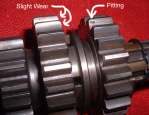
The course says that if a gear has broken teeth, replace both it and its mate on the other shaft. Light pitting and wear lines on teeth are common on high-mileage engines, and a judgement is needed: if the gears are only lightly marked, they can run on. Replace badly pitted, hooked or rounded dogs. Gearbox bearings run in oil and rarely wear out; replace them on a high-value bike, or if they are rough.
What to match when buying
- Engine model and year, and the exact gear (1st, 2nd and so on) and the number of teeth.
- Buy the matching pair (one on each shaft) when replacing a broken gear.
- Ask for new circlips and shims for the shaft.
Fitting notes
- Workshop job. See Assess internal gearbox faults and Take a gearbox apart in order.
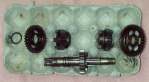
- Take the gears out as a unit. Do not tip them out loose. Use a cardboard egg crate to hold the parts in the order removed.
- Put each part back in the same position and the same way round. Many gears fit backwards and work, but they will have to wear in again.
- Check for shims on shaft ends and keep them with their shaft.