
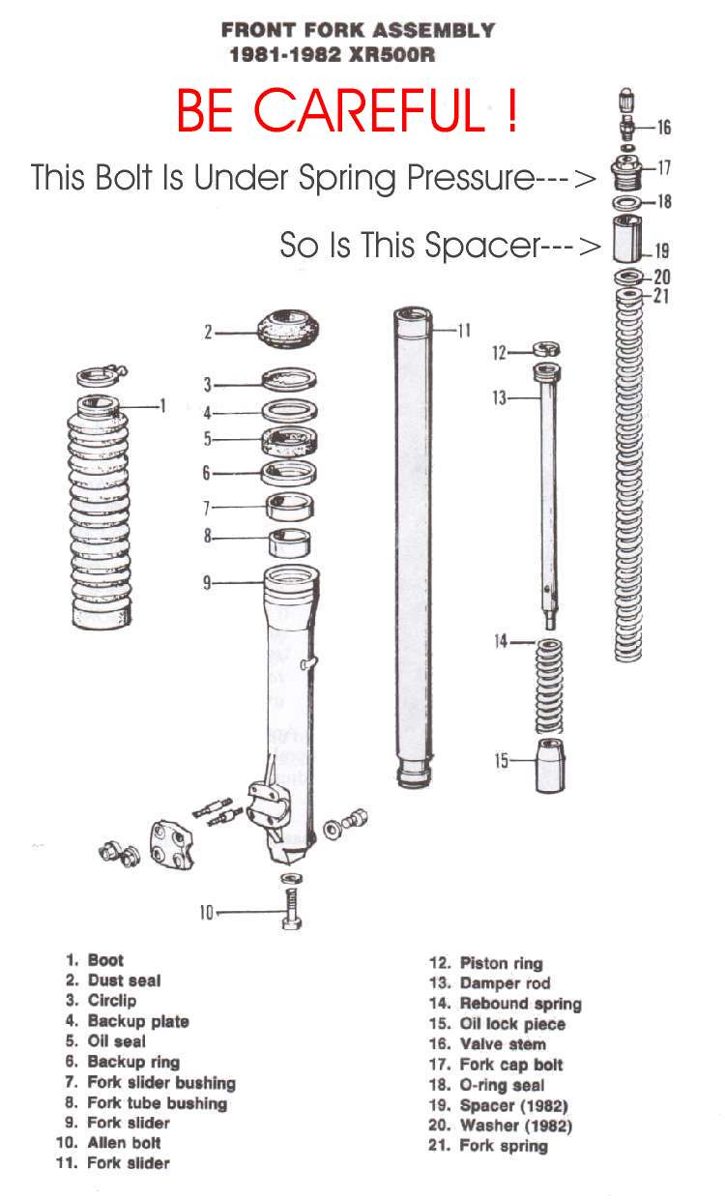
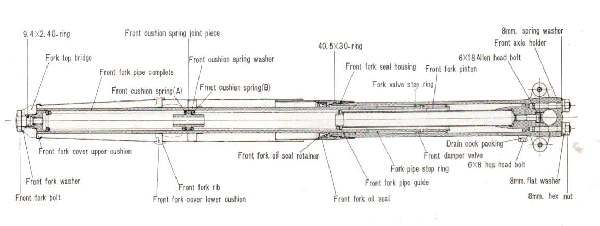
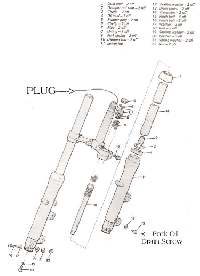
Each fork leg holds a long coil spring inside the tube. A short spacer or tube sits between the spring and the top plug on many forks. Together they carry the weight of the bike and rider at the front.
What it does
The spring holds the front of the bike up and pushes the fork back out after a bump. The spacer sets how much the spring is compressed at rest. Oil in the leg slows the movement, but only the spring carries the load. A tired spring lets the front sit low and bottom out.
Signs it is worn or failing
- Forks hit their stop on bumps or under hard braking: Front forks bottom out.
- Front end sits lower than before, or one leg is shorter than the other: Fork legs are twisted or uneven.
- Harsh ride from a spring that is too stiff or from wrong oil: Front forks feel harsh.
- A broken spring rattles when the front end is moved.
When to replace it
Replace springs as a pair if they have sagged, are shorter than the manual says, or one is broken. Fitting only one new spring gives uneven legs. A thicker oil or a spacer cut to length can stiffen a spring that has sagged a little, as a short-term measure.
What to match when buying
- Spring rate, free length and wire diameter for your bike and load.
- Any preload spacer: length and diameter.
- Whether the fork has two springs or a single spring and a damper rod.
- Buy fork oil of the weight the manual lists: Fork oil.
Fitting notes
- The top bolt or plug is under spring pressure and can fly out when released. Hold it down while loosening and wear eye protection. See Release a spring-loaded fork cap safely.
- Spacer changes: Fit a fork spring spacer.
- Set the oil level after reassembly: Set the fork oil level.