
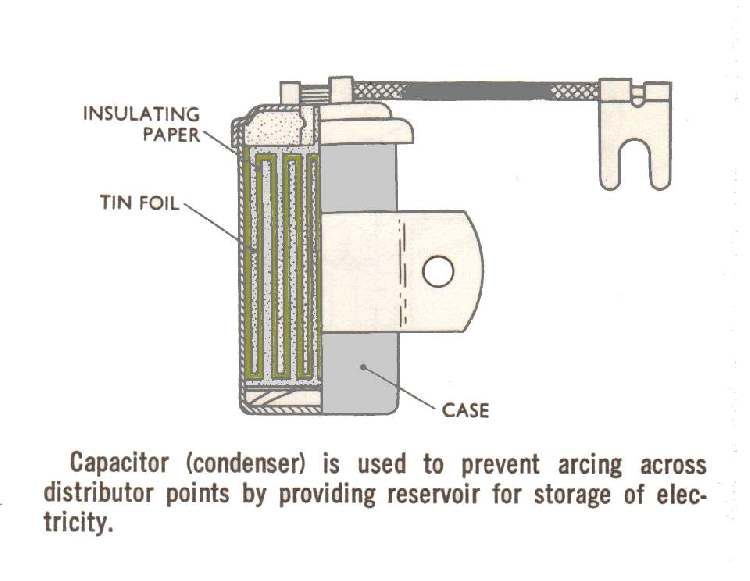
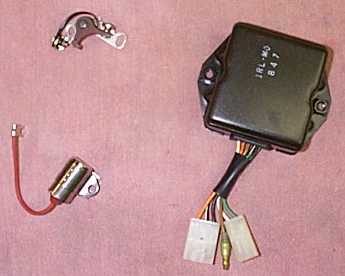
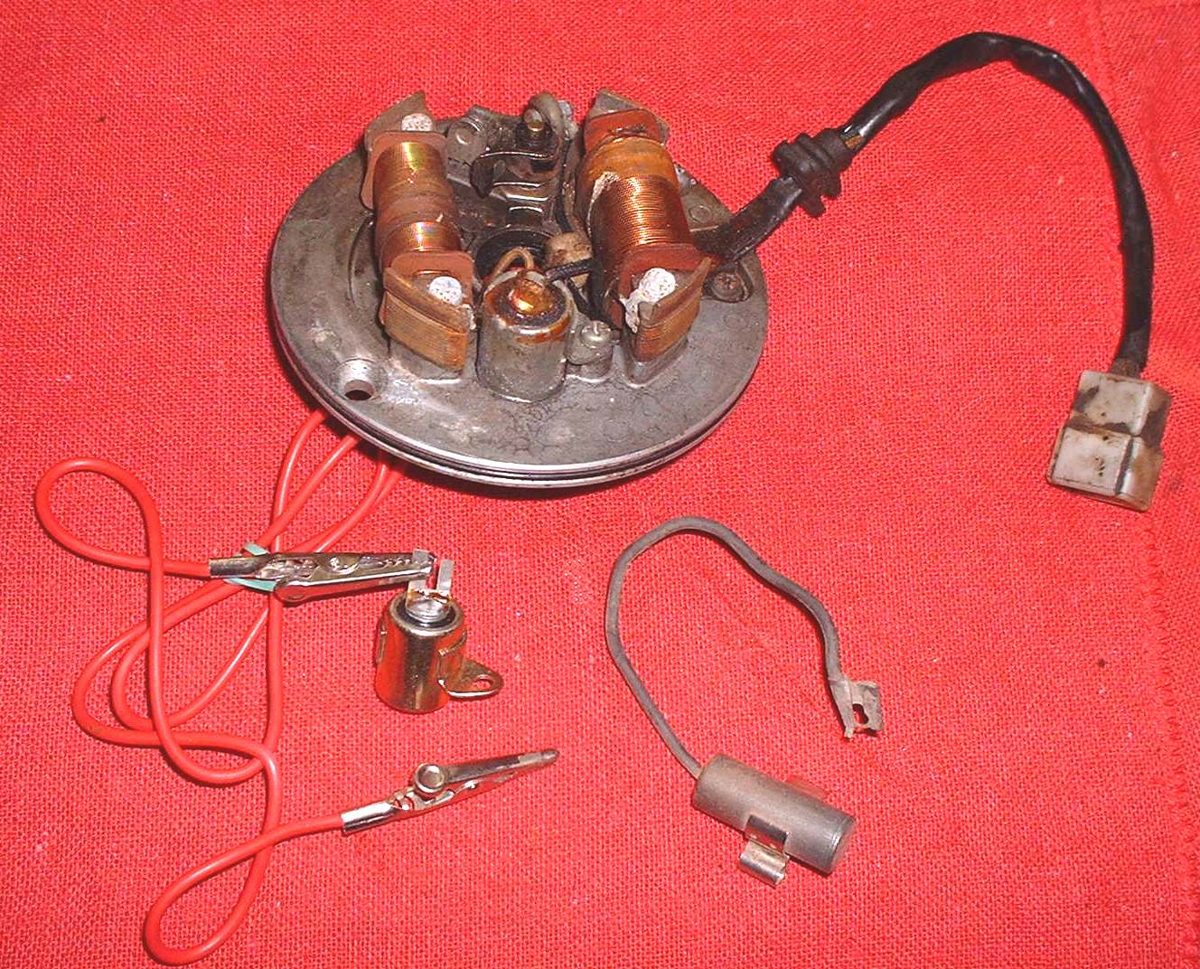
A condenser (capacitor) is a small metal can with a short wire, used with contact breaker points. It looks like a tiny tin. On some engines it sits beside the points; on others it is further along the points wire, even under the fuel tank. Electronic (CDI) ignitions do not use it.
What it does
When the points open, the coil current tries to jump the gap and arc across the contacts. The condenser takes up that surge, so the points open cleanly and the coil gives a strong spark. Its size is matched to the points. If metal builds up on one contact and the other is worn away, the condenser value may be wrong for the set. Material lost from the fixed contact points to a value that is too low; build-up on the fixed contact points to one that is too high.
Signs it is worn or failing
- Heavy arcing at the points and burnt faces that return soon after a new set.
- Weak spark or no spark with good points: Weak, thin or orange spark, No spark at the spark plug.
- Misfire that matches a points problem: Points ignition runs rough or misses.
- A loose earth strap or a broken wire on the can.
When to replace it
Condensers fail rarely. Test it before buying one, and replace it only if it tests bad or the case is cracked or the lead is broken. A simple bench test: charge it from a 12 V battery (lead to positive, case to negative), then touch the lead to the case. A good one gives a fat spark. See Test an ignition condenser.
What to match when buying
- Capacity in microfarads and the physical fit for your engine.
- The correct lead length and the same mounting style (clamp or screw).
- Order the one listed for your engine, not a general one.
Fitting notes
- Keep the can earthed. A poor earth acts like a failed condenser.
- Keep the lead away from the flywheel and the points arm.
- If it was soldered to the points wire, unsolder before testing, then solder the joint again.
- After fitting, check the points face colour after a short run. See Inspect, clean and replace contact breaker points.