
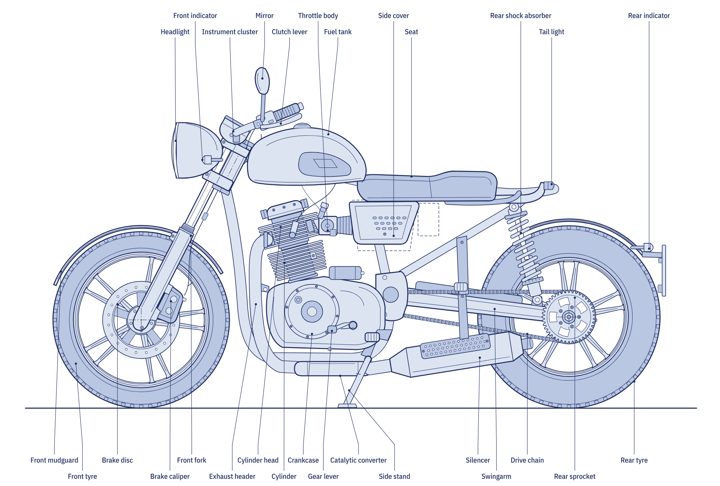
The Moto Zero motorcycle types page groups sixteen types into five families: pioneers, road, off-road, urban and work, and electric. This guide walks through each family, explains what sets each type apart, and links to the full entry with its labelled plate, history and typical specifications.
Pioneers
The pioneer motor-bicycle was a bicycle with an engine bolted in. Gottlieb Daimler and Wilhelm Maybach's wooden Reitwagen of 1885 was the first petrol-engined two-wheeler, and the Hildebrand & Wolfmüller of 1894 was the first offered for sale. These machines used a diamond bicycle frame, a single-cylinder engine of 200 to 500 cc, a belt drive with no clutch or gearbox, and pedals for starting and climbing.
Within two decades the vintage V-twin had arrived: a loop frame, a 45-degree V-twin of 1,000 to 1,200 cc, a hand gear-change on the tank and chain drive. Machines such as the Indian Powerplus and the Brough Superior SS100 were the first true motorcycles rather than motorised bicycles. Our history of the motorcycle follows the story in more detail.
Road motorcycles
Standard roadster
The standard roadster has an upright seat, no fairing and the engine in plain view. It uses a steel cradle or backbone frame, a telescopic fork and chain final drive, with engines from 125 to 1,000 cc. The Triumph Bonneville T120 and the Honda CB750 Four are classic examples, and most riders learn on a machine of this kind.
Café racer
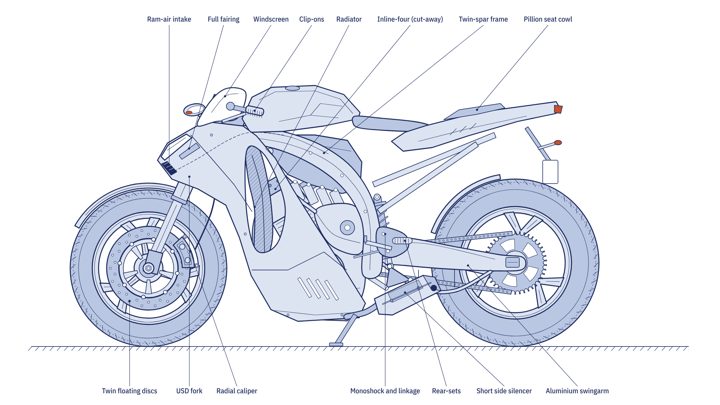
The café racer is a road bike stripped and tuned for speed in the 1960s style: clip-on handlebars mounted low on the fork legs, rear-set footrests for a racing crouch, a long tank and a humped single seat.
Cruiser and chopper
The cruiser has a low stepped seat, a raked fork, forward foot controls and usually a large air-cooled V-twin built for torque at low revs. The long wheelbase gives stability in a straight line rather than quick steering.
Superbike and sport bike
The superbike is a road machine built like a racing bike: an aluminium twin-spar frame, a liquid-cooled engine that revs past 14,000 rpm, an upside-down fork, radial brake calipers, a full fairing and a tucked riding position. The Honda CB750 Four of 1969 started the line, and the CBR900RR Fireblade of 1992 set the pattern of light weight over outright power.
Naked and streetfighter
The naked takes a sport bike's engine and chassis and removes the fairing, adding wide flat bars and an upright, slightly forward riding position. Engines are usually tuned for mid-range torque rather than peak power.
Touring
The touring motorcycle is made to cross continents two-up: a frame-mounted fairing with an adjustable screen, built-in luggage, and often a flat-four or flat-six engine mounted low with shaft final drive, so there is no chain to adjust on a long trip. The Honda Gold Wing is the reference machine.
Off-road motorcycles
Motocross
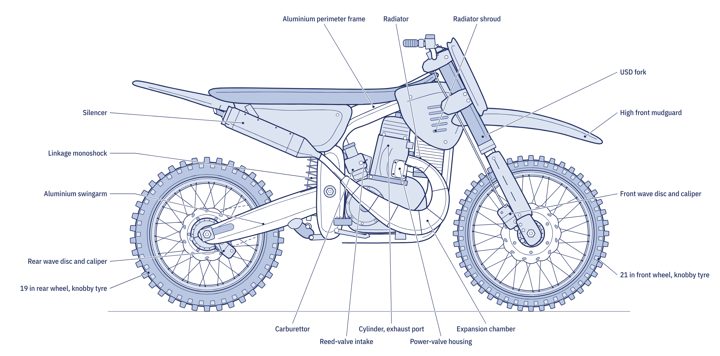
The motocross machine is built to race over jumps and ruts. It has about 300 mm of suspension travel, a 21 in front wheel and an 18 or 19 in rear wheel with knobbly tyres, a liquid-cooled single of 125 to 450 cc, either two-stroke or four-stroke, and no lights, mirrors or stand.
Trials
The trials bike climbs rocks at walking pace and is ridden standing up, so it has almost no seat, a tiny tank, a very short wheelbase and soft tyres run at about 0.3 to 0.5 bar. A complete machine weighs only 65 to 75 kg.
Adventure
The adventure motorcycle is a road tourer that keeps going when the tarmac ends: tall, upright, with long-travel suspension, a 19 or 21 in front wheel, a large fuel tank, crash bars and panniers. The BMW R80G/S of 1980 created the type.
Urban and work motorcycles
Scooter
The scooter has a step-through floor, small 10 to 14 in wheels and a unit-swing engine in which engine, CVT and final drive form one assembly that also acts as the rear swingarm. There is no clutch lever or gear pedal: a variator with roller weights, a V-belt and a centrifugal clutch do the work.
Step-through underbone
The step-through underbone, led by the Honda Super Cub of 1958, has a pressed-steel backbone frame, leg shields, 17 in wheels and a horizontal single under the backbone with a semi-automatic gearbox: the rider changes gear with the foot but has no clutch lever. More than 100 million have been built.
Boda boda commuter
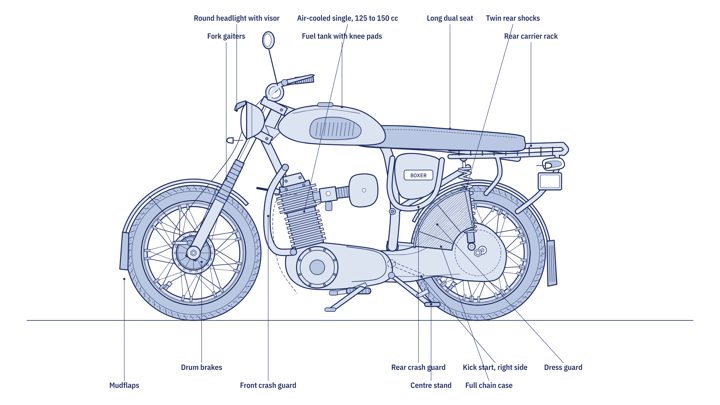
The boda boda is the motorcycle taxi and light truck of East Africa: a rugged air-cooled single of 100 to 150 cc with kick and electric start, a long flat dual seat, a heavy rear carrier, crash guards, drum brakes, a full chain case and a centre stand. The Bajaj Boxer and TVS HLX are common examples. Our boda boda maintenance checklist covers the daily and weekly checks these machines need.
Electric motorcycles
The electric motorcycle puts a lithium-ion battery where the engine was, with a controller and a permanent-magnet motor driving the rear wheel through a single-speed belt or chain. There is no clutch or gearbox, and regenerative braking returns energy to the battery. The electric moped and e-boda goes further, with a hub motor in the rear wheel and a removable battery that can be carried or swapped. Our guide to how electric motorcycles work explains each part.
What the types have in common
Every type shares the same systems: an engine or motor, a drivetrain, a frame with suspension and steering, wheels and brakes, and an electrical system. What changes is the balance between them. A trials bike gives up seat and fuel range for low weight; a touring bike gives up agility for comfort and luggage; a boda boda gives up speed for strength and low running cost. Chapter 1.2 of the course, Types and configurations, adds the legal categories and licence classes that apply to each.
Frequently asked questions
What are the main types of motorcycle?
The main families are road machines (standard, café racer, cruiser, sport, naked and touring), off-road machines (motocross, trials and adventure), urban and work machines (scooter, step-through and commuter) and electric machines.
What is the difference between a scooter and a motorcycle?
A scooter has a step-through floor, small wheels and an automatic CVT with no clutch lever or gear pedal, usually in a unit-swing engine. A motorcycle has the engine in the frame, larger wheels and usually a manual gearbox.
What is a boda boda?
A boda boda is a motorcycle taxi in East Africa, typically a rugged 100 to 150 cc air-cooled single with a long seat, rear carrier, crash guards and drum brakes. Electric boda bodas are growing in number.
What type of motorcycle is best for beginners?
A standard roadster or a small commuter of about 125 cc is the usual starting point, because it has an upright riding position, light controls and predictable power.
Written by Transitions Lab for the Moto Zero open motorcycle course. Text and illustrations are licensed CC BY-SA 4.0. Figures and values come from the course modules; see sources and credits.